
![previous page: 1. Verbascum [Tourn.] L. Sp. Pl. 177. 1753](../../../images/nav/page_prev.gif)


2. Cymbalaria Medic. Phil. Bot. 2: 70. 1791
Description
This section is from the book "An Illustrated Flora Of The Northern United States, Canada And The British Possessions Vol3", by Nathaniel Lord Britton, Addison Brown. Also available from Amazon: An Illustrated Flora of the Northern United States, Canada and the British Possessions. 3 Volume Set..
2. Cymbalaria Medic. Phil. Bot. 2: 70. 1791
Perennial creeping or spreading herbs, with long-petioled, mostly lobed, palmately veined leaves, and solitary axillary white to violet flowers. Calyx 5-parted. Corolla irregular, 2-lipped, short-spurred; upper lip 2-lobed, lower lip 3-lobed; throat nearly or quite closed by the palate. Stamens 4, didynamous, ascending, included, the filaments filiform. Style very slender. Capsule dehiscent by 2 terminal 3-toothed pores. Seeds numerous, small. [From the Greek for cymbal.]
About 9 species, natives of the Old World, the following typical.
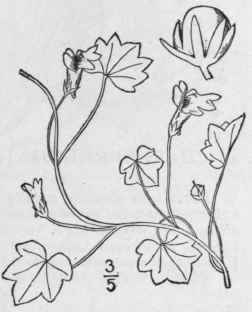
1. Cymbalaria Cymbalaria (L.) Wettst. Kenil-Worth Or Coliseum Ivy
Fig. 3739
Antirrhinum Cymbalaria L. Sp. Pl. 612. 1753. Linaria Cymbalaria Mill. Gard. Dict. Ed. 8, no. 17. 1768. Cymbalaria Cymbalaria Wettst. in Engl. & Prantl, Nat. Pfl. Fam. 4: Abt. 3b, 58. 1891.
Perennial, glabrous; stem trailing, branched, often rooting at the nodes, 3-12' long. Leaves slender-petioled, • reniform-orbicular, palmately 3-5-veined,3-5-lobed,1/4'-1' in diameter, the lobes broad and obtuse; petioles usually as long as the blade; flowers axillary, solitary, blue or lilac, 4"-5" long; peduncles slender, recurved, shorter than the petioles; calyx-segments lanceolate, acute; palate yellowish; capsule globose, several-seeded; seeds rugose, wingless.
Waste places and roadsides, adventive from Europe, Ontario to New Jersey and Pennsylvania, and in seaport ballast. Other English names are ivy-leaved toadflax, ivy-weed. Climbing or roving sailor. Aaron's-beard. Wandering jew. Mother-of-thousands. Oxford-weed. Pennywort. June-Aug.
Continue to:


My Books

