


19. Lamium [Tourn.] L. Sp. Pl. 579. 1753
Description
This section is from the book "An Illustrated Flora Of The Northern United States, Canada And The British Possessions Vol3", by Nathaniel Lord Britton, Addison Brown. Also available from Amazon: An Illustrated Flora of the Northern United States, Canada and the British Possessions. 3 Volume Set..
19. Lamium [Tourn.] L. Sp. Pl. 579. 1753
Annual or perennial mostly diffuse herbs, with crenate dentate or incised, usually cordate leaves, and rather small flowers, verticillate in axillary and terminal clusters. Calyx tubular-campanulate, about 5-nerved, 5-toothed, the teeth sharp, equal or the upper ones longer. Tube of the corolla mostly longer than the calyx, dilated above, its limb 2-lipped; upper lip concave, erect, usually entire, narrowed at the base; lower lip spreading, 3-cleft, the middle lobe emarginate, contracted at the base, the lateral ones sometimes each with a tooth-like appendage. Stamens 4, didynamous, ascending under the upper lip of the corolla, the anterior pair the longer; anthers 2-celled, the sacs divaricate, often hirsute on the back. Ovary deeply 4-parted; style 2-cleft at the summit. Nutlets smooth or tuberculate. [Greek, throat, from the ringent corolla.]
About 40 species, natives of the Old World, known as Dead-Nettie or Hedge Dead-Nettie. Type species: Lamium purpureum L.
Upper leaves sessile or clasping.
1. L. amplexicaule.
Leaves all petioled.
Flowers red or purple.
Corolla 6"- 9" long; leaves not blotched.
2. L. purpureum.
Corolla 10"- 12" long; leaves commonly blotched.
3. L. maculatum.
Flowers white.
4. L. album.
1. Lamium Amplexicaule L. Henbit. Greater Henbit. Henbit Dead Nettle
Fig. 3610
Lamium amplexicaule L. Sp. Pl. 579. 1753.
Biennial or annual, sparingly pubescent; stems branched from the base or also from the lower axils, slender, ascending or decumbent, 6'-18' long. Leaves orbicular or nearly so, coarsely crenate, 1/2' - 1 1/2' wide, rounded at the apex, the lower slender-petioled, mostly cordate, the upper sessile and more or less clasping; flowers rather few in axillary and terminal clusters; calyx pubescent, its teeth erect, nearly as long as the tube; corolla purplish or red. 6"-8" long, its tube very slender, the lateral lobes of its lower lip very small, the middle one spotted; upper lip somewhat pubescent; flowers sometimes cleistogamous.
In waste and cultivated ground, New Brunswick to Ontario, Minnesota, British Columbia, Florida, Arkansas and California and in Bermuda and Jamaica. Naturalized from Europe. Native also of Asia. Feb Oct.


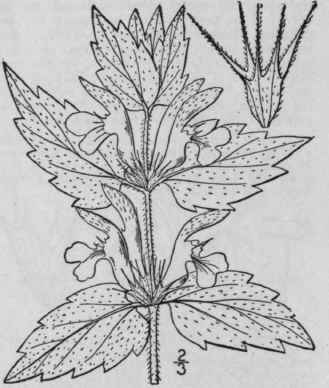
2. Lamium Purpureum L. Red Dead Nettle
Fig. 3611
Lamium purpureum L. Sp. Pl. 579. 1753.
Annual, slightly pubescent, branched from the base and sometimes also above; stems stout or slender, decumbent, 6'-18' long. Leaves crenate or crenulate, the lower orbicular or broadly ovate, slender-petioled, rounded at the apex, cordate at the base, the upper ovate, short-petioled, sometimes acute at the apex, 1/2' - 1 1/4' long; flowers in axillary and terminal clusters; calyx teeth narrowly lanceolate, acuminate, slightly longer than the tube, spreading, at least in fruit; corolla purple-red, rarely exceeding 1/2' long, its tube rather stout, the lateral lobes of its lower lip reduced to 1 or 2 short teeth, its middle lobe spotted; upper lip very pubescent.
In waste and cultivated soil, Newfoundland to Pennsylvania, North Carolina and Missouri. Also in ballast about the northern seaports. Naturalized or adventive from Europe. Native also of Asia. Old names, red or sweet archangel; day-, dog-, french- or deaf-nettle. Rabbit-meat. April-Oct.
Lamium hybridum Vill., occasionally found in waste and cultivated grounds, introduced from Europe, differs by its more deeply and incisely toothed leaves.
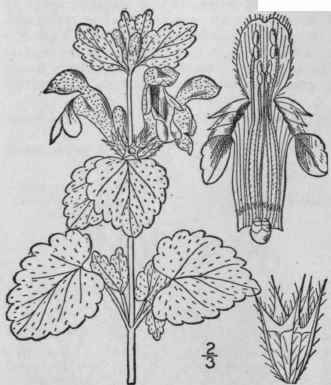
3. Lamium Maculatum L. Spotted Dead Nettle. Variegated Dead Nettle
Fig. 3612
L. maculatum L. Sp. Pl. Ed. 2, 809. 1763.
Perennial, somewhat pubescent; stems mostly slender, commonly branched, decumbent or ascending, 8'-1 1/2° long. Leaves crenate or incised-crenate, all petioled, usually longitudinally blotched along the midrib, broadly ovate or triangular-ovate, acute or obtuse, truncate or cordate at the base, 1'-2' long, or some of the lower ones much smaller and nearly orbicular; clusters few-flowered, mainly axillary; calyx-teeth lanceolate-subulate, as long as or longer than the tube, spreading; corolla io"-I2" long, purple-red, its tube short, contracted near the base, with a transverse ring of hairs within, the lateral lobes of its lower lip very small.
Along roadsides, escaped from gardens, Maine and Vermont to Virginia. Native of Europe and Asia. May-Oct.
4. Lamium Album L. White Dead Nettle
Fig. 3613
Lamium album L. Sp. Pl. 579. 1753.
Perennial, pubescent; stems decumbent or ascending, rather stout, simple or branched, 1°- 1 1/2° long. Leaves ovate, crenate, dentate or incised, all petioled, acute or acuminate at the apex, cordate or truncate at the base, l' - 3' long, or the lower shorter and obtuse; clusters mostly axillary; calyx-teeth very slender, subulate, spreading, usually longer than the tube; corolla white, about 1' long, its tube short, stout, contracted near the base, with an oblique ring of hairs within, the lateral lobes of its lower lip each with a slender tooth.
In waste places, Ontario to Massachusetts and Virginia. Also in ballast about the northern seaports. Naturalized or adventive from Europe. Old names, white archangel; day-, blind-, dumb-or bee-nettle; snake-flower, suck-bottle. April-Oct.
Continue to:


My Books

