


19. Agoseris Raf.; D. Dietr. Syn. Pl. 4: 1332. 1847
Description
This section is from the book "An Illustrated Flora Of The Northern United States, Canada And The British Possessions Vol3", by Nathaniel Lord Britton, Addison Brown. Also available from Amazon: An Illustrated Flora of the Northern United States, Canada and the British Possessions. 3 Volume Set..
19. Agoseris Raf.; D. Dietr. Syn. Pl. 4: 1332. 1847
[Troximon Nutt. Fras. Cat. 1813. Not Gaertn. 1791.]
Perennial or annual herbs, mostly acaulescent, with tufted usually sessile basal leaves, and solitary heads of yellow or rarely purple flowers at the end of a naked or bracted scape. Involucre campanulate or oblong, its bracts imbricated in several series, appressed, or with spreading tips, membranous or herbaceous, not thickened after flowering, the outer ones gradually shorter and broader. Receptacle flat, naked or foveolate. Rays truncate and 5-toothed at the apex. Anthers sagittate at the base. Style-branches slender. Achenes oblong, obovate, or linear, 10-ribbed, not flattened, beaked or beakless. Pappus of copious slender simple white bristles or soft unequal narrow scales. [Greek, head- or chief-succory.]
About 30 species, natives of western and southern North America and southern South America. Besides the following, some 20 others occur in the western parts of the United States. Type species: Agoseris cuspidata (Pursh) D. Dietr.
Achenes beaked.
Head 1'-2' broad, achenes 5"-6" long.
1. A. glauca.
Head 1-2 broad: achenes 5 -6 long.
2. A. parviflora.
Achenes beakless.
3. A. cuspidata.
1. Agoseris Glauca (Pursh) D. Dietr. Large-Flowered Agoseris
Fig. 4081
T. glaucum Pursh, Fl. Am. Sept. 505. 1814. Agoseris glauca D. Dietr. Syn. Pl. 4: 1332. 1847.
Perennial, pale or glaucous, glabrous throughout or a little woolly below. Leaves linear, lanceolate, or oblong, entire, dentate or pinna-tifid, 2'-10' long, 2"-10" wide, acuminate at the apex, narrowed at the base, sometimes into margined petioles; scapes stout, glabrous or slightly pubescent, longer than the leaves, often 1 1/2° high; head 1'-2' broad; involucre oblong-campanulate, or broader in fruit, commonly quite glabrous, its bracts lanceolate, acuminate, often hyaline-margined; achenes conspicuously beaked, 5"-6" long, when mature longer than the copious pappus of rather rigid scabrous or denticulate bristles.
Minnesota to South Dakota, Saskatchewan, south to Kansas (according to Smyth), Colorado and Utah. May-July.

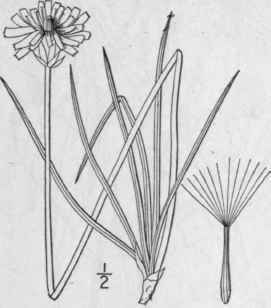
2. Agoseris Parviflora (Nutt.) D. Dietr. Small-Flowered Agoseris
Fig. 4082
Troximon parviflorum Nutt. Trans. Am. Phil. Soc. 7:
434. 1841. Troximon glaucum var. parviflorum A. Gray, Syn. Fl.
1: Part 2, 437. 1884. Agoseris parviflora D. Dietr. Syn. Pl. 4: 1332. 1847.
Perennial, glabrous throughout; scape slender, much longer than the leaves, 5'-15' high. Leaves narrowly linear, acuminate, entire, 3's' long, 1"-21/2" wide; head 1' broad or less; involucre oblong-ovoid, becoming nearly hemispheric in fruit, 6"-8" high, glabrous, its bracts lanceolate, acuminate; achenes conspicuously beaked, about 4" long; pappus of numerous unequal very slender bristles.
Plains, North Dakota to Nebraska, Manitoba, Alberta, Idaho and New Mexico. Called also false dandelion. May-July.

Continue to:


My Books

