


Chamaesýce S. F. Gray, Nat. Arr. Part 2
Description
This section is from the book "An Illustrated Flora Of The Northern United States, Canada And The British Possessions Vol2", by Nathaniel Lord Britton, Addison Brown. Also available from Amazon: An Illustrated Flora of the Northern United States, Canada and the British Possessions. 3 Volume Set..
Chamaesýce S. F. Gray, Nat. Arr. Part 2
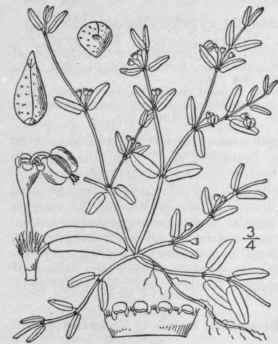
1. Chamaesyce Polygonifòlia (L.) Small. Seaside Or Knotweed Spurge
Fig. 2732
Euphorbia polygonifolia L. Sp. Pl. 455. 1753.
Chamaesyce polygonifolia Small, Fl. SE. U. S. 708. 1903.
Annual, pale green, glabrous, stem branched from the base, the branches radiately spreading, prostrate, forked, wiry, 3'-8' long. Leaves opposite, oblong, linear-oblong or linear-lanceolate, 3"-10" long, fleshy, obtuse, often mucronulate, entire, obtuse or subcordate and somewhat oblique at the base, short-petioled; stipules an inconspicuous fringe of short bristles; involucres usually solitary in the axils, turbinate-campanulate, less than 1" long, with 4 columnar nearly naked glands shorter than the lobes; peduncles twice as long as the involucres; capsule globose-ovoid, 1 /2"-2" long, nodding, minutely wrinkled; seeds ovoid, 1 1/2" long, somewhat flattened, ash-colored, very minutely pitted and spotted.
In sand along the Atlantic coast, Nova Scotia to Florida, and on the shores of the Great Lakes. Shore-spurge. July-Sept.

2. Chamaesyce Geýeri (Engelm. & Gray) Small. Geyer's Spurge
Fig. 2733
Euphorbia Geyeri Engelm. & Gray, Bost. Journ. Nat.
Hist. 5: 260. 1847. C. Geyeri Small, Fl. SE. U. S. 709. 1903.
Annual, olive-green, glabrous. Stem branched from the base, the prostrate branches radiately spreading, wiry, 2'-15' long; leaves oblong or ovate, 2"-6" long, obtuse, usually mucronulate, entire or nearly so, oblique, obtuse or subcordate at the base, short-petioled; stipules a fringe of short setae; involucres usually solitary in the axils, campanulate, about 1/2" high, with 4 wineglass-shaped glands shorter than the lobes, each subtended by an inconspicuous white or red entire or lobed appendage; peduncles as long as the involucres, or longer; capsule globose-reni-form, about 1" long, nodding; seeds narrowly ovoid, 3/4" long, ash-colored, nearly terete.
In sandy soil, Illinois to Minnesota, South Dakota and Kansas. July-Sept.
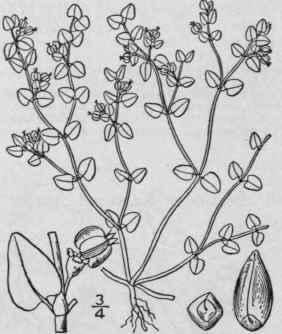
3. Chamaesyce Serpens (H.B.K.) Small. Round-Leaved Spreading Spurge
Fig. 2734
Euphorbia serpens H.B.K. Nov. Gen. 2: 52. 1817. Chamaesyce serpens Small, Fl. SE. U. S. 709. 1903.
Annual, pale green, glabrous, sometimes glau-cescent. Stem branched from the base, the slender or filiform branches prostrate, 2'-12' long; leaves orbicular, orbicular-ovate or oval, 1" - 3" long, obtuse or emarginate, entire, often slightly revolute-margined, short-petioled, the base oblique, rounded or subcordate; stipules triangular, somewhat incised at the apex; peduncles slightly longer than the petioles; involucres solitary in the axils, nearly 1/2" high, bearing 4 sessile saucer-shaped glands shorter than the lobes, each subtended by a minute irregular crenulate appendage; capsule nodding, depressed-globose, 1" in diameter; seeds oblong-ovoid, i" long, smooth, obtusely 4-angled, light gray.
Illinois to Iowa, western Ontario, South Dakota and Kansas, south to Mexico. West Indies. In ballast about the eastern seaports. March-Oct.
Continue to:


My Books

