


27. Cercocàrpus H.B.K. Nov. Gen. Et Sp. 6: 232. 1823. Part 6
Description
This section is from the book "An Illustrated Flora Of The Northern United States, Canada And The British Possessions Vol2", by Nathaniel Lord Britton, Addison Brown. Also available from Amazon: An Illustrated Flora of the Northern United States, Canada and the British Possessions. 3 Volume Set..
27. Cercocàrpus H.B.K. Nov. Gen. Et Sp. 6: 232. 1823. Part 6
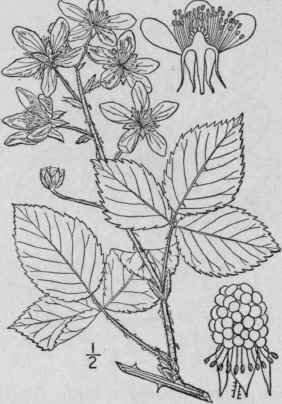
13. Rubus Alleghaniénsis Porter. Mountain Blackberry
Fig. 2300
Rubus villosus var. montanus Porter, Bull. Torr.
Club 17: 15. 1890. Rubus montanus Porter, Bull. Torr. Club 21:
120. 1894. Not Ort. 1852. Rubus alleghaniensis Porter, Bull. Torr. Club 23:
153. 1896. R. nigrobaccus Bailey, Sk. Ev. Nat. Fr. 379, /. 59, 60. 1898.
Stems reddish or purple, very prickly, erect, arching or ascending, 2°-8° high. Leaflets ovate to ovate-lanceolate, acute or acuminate, pubescent, at least beneath, the inflorescence more or less glandular-hispid; flowers several in rather loose racemes; fruit oblong, oblong-conic or thimble-shaped, 8"-14" long, 3"-4" in diameter; racemes sometimes very long; drupelets oblong when dry, rarely yellowish.
In dry soil, Nova Scotia to Ontario, New York, Virginia and North Carolina. May-July. Fruit ripe Aug.-Sept. High-bush blackberry.
14. Rubus argùtus Link. Tall Blackberry. Thimble-berry. Cloud-berry. Fie. 2WI, Rubus argutus Link, Enum. Hort. Berol. 2: 60. 1822.
Shrubby, branched, perennial, pubescent; stems erect or recurved, 3°-10° long, armed with stout prickles. Stipules linear or lanceolate; leaves 3-5-foliolate; leaflets ovate or ovate-oblong, acute or acuminate, coarsely and unequally serrate, densely pubescent beneath, the terminal one stalked; inflorescence racemose, villous, often glandular and prickly; bracts small; flowers 9"-12" broad; petals white, obovate, much exceeding the sepals; fruit black, pulpy, 6"-12" long.
In dry soil, mostly at low altitudes, Massachusetts to Virginia. Finger-berry. Sow-tit. May-June. Fruit ripe July-Aug. Included in our first edition in the description of Rubus villosus Ait., which name has been erroneously applied by most authors.
Rubus laciniàtus Willd., found escaped from cultivation in southern New York, Pennsylvania and Delaware, has laciniate or pinnatifid leaflets. It is a native of Europe.
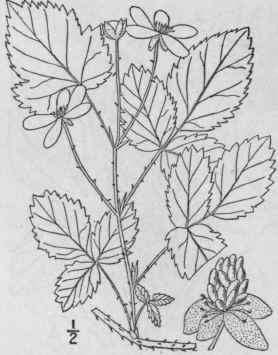
15. Rubus Baileyànus Britton. Bailey's Blackberry
Fig. 2302
Rubus villosus var. humifusus T. & G. Fl. N. A. 1:
455. 1840. Not R. humifusus Weihe, 1825. R. Baileyanus Britton, Mem. Torr. Club 5: 185. 1894.
Stem trailing or ascending, sparingly prickly, 3°-6° long. Leaflets broadly ovate or oval, pubescent, at least on the lower surface, mostly rounded or cordate at the base, acute or obtuse, the uppermost leaves almost invariably unifoliolate; flowers few, rather large; fruit small, not as succulent as that of the related species.
In dry woods and thickets, Massachusetts to southern New York and Virginia. May-June.
Rubus Rándii (Bailey) Rydb., referred to this species in our first edition, appears to be a hybrid, with R. canadensis L. as one of its parents.
Continue to:


My Books

