


18. Myosurus L. Sp. Pl. 284. 1753
Description
This section is from the book "An Illustrated Flora Of The Northern United States, Canada And The British Possessions Vol2", by Nathaniel Lord Britton, Addison Brown. Also available from Amazon: An Illustrated Flora of the Northern United States, Canada and the British Possessions. 3 Volume Set..
18. Myosurus L. Sp. Pl. 284. 1753
Diminutive annual herbs, with fibrous roots, tufted, basal linear or linear-spatulate, entire leaves and 1-flowered scapes. Sepals 5 (rarely 6-7), long-spurred at the base. Petals the same number or none, when present greenish-yellow, narrow, the claw bearing a nectariferous pit at the summit, the limb spreading. Stamens 5-25, about equalling the sepals. Pistils numerous, borne on a central axis, which becomes greatly elongated in fruit. Ovule 1, suspended. Achenes apiculate or aristate. [Greek, mouse-tail.]
A genus of insignificant plants of local but wide geographic distribution, consisting of the species here figured and about 4 others found in west America and Australia. Type species: Myosurus minimus L.
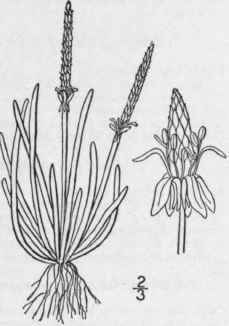
1. Myosurus Minimus L. Mouse-Tail
Fig. 1893
Myosurus minimus L. Sp. Pl. 284. 1753.
Myosurus Shortii Raf. Am. Journ. Sci. 1: 379. 1819.
Myosurus minimus var. Shortii Huth, Engler's Bot. Jahrb. 16: 284. 1893.
Low, glabrous, 1'-6' high, the scape at length surpassing the leaves and the elongated receptacle attaining the length of 1'-2'. Leaves all basal, 2'-4' long, narrowly spatulate to linear, blunt; petals present, small; achenes glabrous, apiculate.
In moist places, southern Ontario to British Columbia, Indiana, Virginia, Florida, Texas and New Mexico. Reported from the Pacific Coast. Also in central Europe. At Norfolk, Va., the plant seems to have been introduced. Little mouse-tail. Blood-strange. April-July.
Continue to:


My Books

