


12. Radicula Hill, Brit. Herb. 265. 1756. Part 2
Description
This section is from the book "An Illustrated Flora Of The Northern United States, Canada And The British Possessions Vol2", by Nathaniel Lord Britton, Addison Brown. Also available from Amazon: An Illustrated Flora of the Northern United States, Canada and the British Possessions. 3 Volume Set..
12. Radicula Hill, Brit. Herb. 265. 1756. Part 2
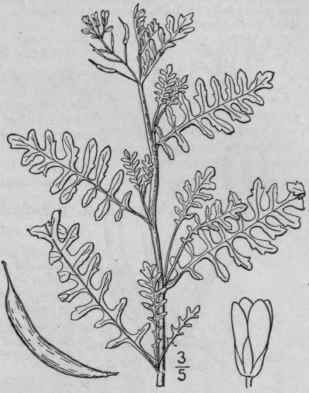
2. Radicula Sinuàta (Nutt.) Greene. Spreading Yellow-Cress
Fig. 2027
Nasturtium sinuatum Nutt.; T. & G. Fl. N. A. 1: 73. 1838.
Roripa sinuata A. S. Hitchcock, Spring Fl. Manhattan 18. 1894.
Radicula sinuata Greene, Leaflets 1: 113. 1905.
Perennial, diffuse, glabrous, the branches ascending. Leaves oblong, lanceolate, or oblanceolate, 2'-3' long, 1/2'-1' wide, pinnatifid, the lobes linear or oblong, obtuse, entire, or sparingly dentate; pedicels slender, 3" long; flowers yellow, about 2" broad; pods linear-oblong, sometimes slightly curved, smooth or a little roughened, 4"-6" long; style slender, 1"-1 1/2" long.
In dry or moist sandy soil, Illinois and Minnesota to Assiniboia, Washington, Missouri, Texas and Arizona. St. Thomas, Canada. June-Sent. Has been mistaken for R. curvisiliqua (Hook.) Greene.

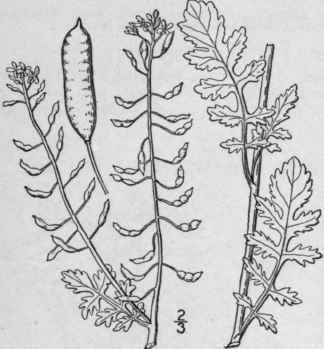
3. Radicula Obtùsa (Nutt.) Greene, Blunt-Leaved Yellow-Cress
Fig. 2028
Nasturtium obtusum Nutt.; T. & G. Fl. N. A. I:
74. 1838. Roripa obtusa Britton, Mem. Torr. Club 5: 169.
1894. Radicula obtusa Greene, Leaflets, 1: 113. 1905.
Annual or biennial, diffuse, much-branched, the branches ascending or erect. Leaves oblong or oblanceolate, 2'-4' long, pinnately divided, or pinnatifid, the lobes obtuse, repand-toothed, or sometimes entire; pedicels 1"-2" long; flowers yellow, 1" broad or less; pods narrowly oblong, or linear, 3"-5" long, ascending; style i" long.
In low grounds, Michigan to Missouri, Texas, Montana and California. April-Aug.
4. Radicula Sphaerocàrpa (A. Gray) Greene. Round-Fruited Cress
Fig. 2029
Nasturtium sphaerocarpum A. Gray, Mem. Am. Acad.
4: 6. 1849. Roripa sphaerocarpa Britton, Mem. Torr. Club 5:
170. 1894. R. obtusa sphaerocarpa Robinson, Rhodora 10: 32.
1908. Radicula sphaerocarpa Greene, Leaflets, 1: 113. 1905.
Glabrous, stem erect or decumbent, usually branched, slender, 4'-12' high. Leaves oblong, obtuse, the lower lyrate-pinnatifid or incised, the upper sometimes nearly entire, all petioled or the upper subsessile; petioles narrowly margined, somewhat clasping at the base; flowers 1" broad or less; petals yellow, about equalling the sepals; silicle globose, or subglobose, 1"-2" in diameter, about as long as its pedicel; style very short.
Illinois to Kansas, Texas and California. Perhaps a short-podded race of the preceding species. June-July.

5. Radicula Palústris (L.) Moench. Marsh Or Yellow Water-Cress
Fig. 2030
Sisymbrium amphibium var. palustre L. Sp.
Pl. 657. I753. Radicula palustris Moench, Meth. 263. 1794. Nasturtium terrestre R. Br. in Ait. Hort. Kew.
Ed. 2, 4: no. 1812. Nasturtium palustre DC. Syst. 2: 191. 1821. Roripa palustris Bess. Enum. 27. 1821.
Annual, or biennial, erect, branching, glabrous or slightly pubescent, 1°-3 1/2° high. Lower leaves petioled, 3'-7' long, oblong or oblanceolate, deeply pinnatifid (rarely only dentate), the lobes acutish or blunt, repand or toothed; upper leaves nearly sessile, dentate or somewhat lobed; base of the petiole often dilated and clasping; pedicels slender, 3" long in fruit; flowers yellow, 2"-3" broad; pods linear, or linear-oblong, 2-6 times as long as thick, about equalling the pedicels, spreading or curved; style i" long or less.
In wet places, nearly throughout North America except the extreme north. Apparently in part naturalized from Europe on the eastern side of the continent, but widely indigenous. Yellow wood-cress. May-Aug.
Continue to:


My Books

