


11. Hibiscus L. Sp. Pl. 693. 1753. Part 2
Description
This section is from the book "An Illustrated Flora Of The Northern United States, Canada And The British Possessions Vol2", by Nathaniel Lord Britton, Addison Brown. Also available from Amazon: An Illustrated Flora of the Northern United States, Canada and the British Possessions. 3 Volume Set..
11. Hibiscus L. Sp. Pl. 693. 1753. Part 2
2. Hibiscus Oculiròseus Britton. Crimson-Eye Rose-Mallow
Fig. 2870
Hibiscus oculiroseus Britton, Journ. N. Y. Bot. Gard. 4: 220. 1903.
Similar to the preceding species in stems, foliage and pubescence, and about as high, the flowers about as large. Calyx-segments triangular-lanceolate, acute, nearly twice as long as wide; corolla white with a dark crimson center; capsule ovoid-conic, long-pointed.
In salt marshes, southeastern New York and New Jersey. A hybrid, with intermediate characters between this and the preceding, occurs on Staten Island, and also appeared in the New York Botanical Garden. Aug.-Sept.
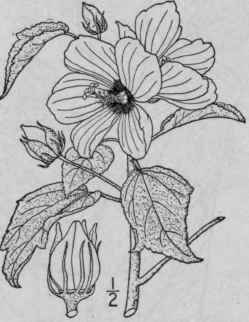
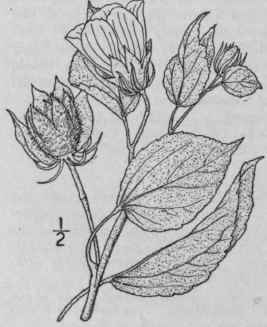
3. Hibiscus Incànus Wendl. Velvety Rose-Mallow
Fig. 2871
Hibiscus incanus Wendl. Bot. Beob. 54. 1798.
Perennial, erect, 6° high or less. Leaves ovate or broadly lanceolate, 4'-7' long, acuminate at the apex, obtuse or subcordate at the base, dentate, rarely somewhat lobed, pale and finely velvety beneath, dark green above, long-petioled; bractlets linear, not ciliate, about half as long as the velvety calyx; calyx-segments ovate, acute or acuminate; petals white to pink, blotched at the base, 3'-4' long; capsule ovoid, stellate-pubescent, rather shorter than the calyx.
Marshes, Maryland to Florida and Louisiana. May-Aug.
4. Hibiscus Lasiocàrpus Cav. Hairy-Fruited Rose-Mallow
Fig. 2872
Hibiscus lasiocarpus Cav. Diss. 3: 159. pl. 70. f. 1.
1787.
Resembles the three preceding species. Leaves broadly ovate, dentate or 3-7-lobed, mostly cordate or truncate at the base; pubescence of the lower surface white and densely stellate, the upper surface darker, with longer soft mostly nearly simple hairs; bractlets of the involucels linear, equalling the calyx or shorter, ciliate; capsule ovoid, densely and finely hairy; seeds.nearly glabrous.
In swamps, southern Indiana to Missouri, south to Florida and Texas. Aug.

5. Hibiscus Militàris Cav. Halberd-Leaved Rose-Mallow. Sweating-Weed
Fig. 2873
Hibiscus militaris Cav. Diss. 3: 352. pl. 198. f. 2. 1787.
Hibiscus virginicus Walt. Fl. Car. 177. 1788. Not L. 1753.
Erect, 3°-5° high, nearly glabrous throughout. Leaves 4'-5' long, ovate in outline, acute or acuminate, cordate or truncate at the base, the lower, or sometimes all, hastately lobed, the margins dentate-crenate; petioles 1'-6' long; flowers pink with a darker eye, 2'-3' long, axillary or clustered at the ends of the stem or branches; peduncles shorter than the petioles and jointed above the middle; bractlets of the involucels linear, slightly shorter than the calyx, glabrous, or with a few scattered hairs; fruiting calyx inflated; capsule ovoid, enclosed by the calyx, glabrous, or very nearly so; seeds silky.
Along rivers, southern Pennsylvania to Florida, west to Minnesota, Nebraska and Louisiana. Aug.-Sept.

Continue to:


My Books

