


11. Cogswéllia Spreng.; Roem. & Schultes, Syst. Veg. 6: XLVIII. 1820
Description
This section is from the book "An Illustrated Flora Of The Northern United States, Canada And The British Possessions Vol2", by Nathaniel Lord Britton, Addison Brown. Also available from Amazon: An Illustrated Flora of the Northern United States, Canada and the British Possessions. 3 Volume Set..
11. Cogswéllia Spreng.; Roem. & Schultes, Syst. Veg. 6: XLVIII. 1820
[Lomatium Raf. Journ. Phys. 89: 101. 1819. Not Lomaiia R. Br. 1810.] Perennial herbs, acaulescent or nearly so, from thick fusiform or tuberous roots, with ternate, pinnate, or in our species bipinnate or finely dissected leaves, and compound umbels of white or yellow flowers. Involucre none. Involucels of several or numerous bracts. Calyx-teeth mostly obsolete. Stylopodium depressed or none. Fruit oval, oblong or orbicular, glabrous or pubescent, dorsally compressed. Carpels with filiform dorsal and intermediate ribs, the lateral ones broadly winged; oil-tubes 1-4 (rarely more) in the intervals, 2-10 on the commissural side. Seed-face flat or slightly concave. [Name in honor of Cogswell.]
About 60 species, of western North America. Type species: Cogswellia villosa (Raf.) Spreng. The species of this genus were previously referred to the Old World Peucedanum and their specific names wrongly applied.
Flowers white or pinkish. | 1. | C. orientalis. |
Flowers yellow. | ||
Fruit glabrous; involucel-bracts united. | 2. | C. daucifolia. |
Fruit finely pubescent; involucel-bracts linear, distinct. | 3. | C. foeniculacea. |
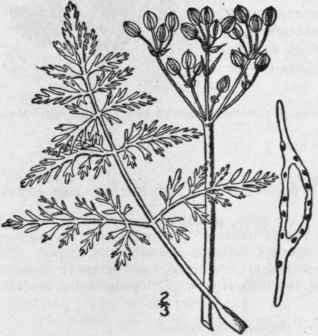
1. Cogswellia Orientális (Coult. & Rose) M. E. Jones. White-Flowered Parsley
Fig. 3117
Lomatium orientale Coult. & Rose, Contr. U. S.
Nat. Herb. 7: 220. 1900. Cogswellia orientalis M. E. Jones, Contr. West.
Bot. 12: 33. 1908.
Finely pubescent, the leaves and peduncles 3'-8' high. Root elongated, often swollen in places. Leaves bipinnate, the segments oblong or ovate, generally pinnatifid into linear or linear-oblong obtusish lobes; bracts of the involucels lanceolate, scarious-margined; umbel 4-8-rayed, the rays unequal, 1/2'-1 1/2' long in fruit; pedicels 1"-3" long; flowers white or pinkish; fruit broadly oval or orbicular, glabrous, 2"-3" long, the lateral wings narrower than the carpel, the dorsal and intermediate ones inconspicuous; oil-tubes generally solitary in the intervals, about 4 on the commissural side.
In dry soil, Iowa and Minnesota to North Dakota, Washington, Kansas, Iowa and New Mexico. Confused in previous writings with C. nudicaulis of the Northwest. March-May.
2. Cogswellia Daucifòlia (Nutt.) M.E.Jones. Carrot-Leaved Parsley
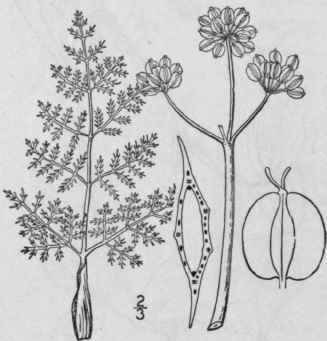
Fig. 3118
Peucedanum daucifolium Nutt.; T. & G. Fl. N.
A. 1: 627. 1840. Peucedanum foeniculaceum daucifolium T. &
G Fl. N. A. 1: 627. 1840. Cogswellia daucifolia M. E. Jones, Contr.
West. Bot. 12: 34. 1908.
Tomentose-pubescent, or becoming nearly glabrous; peduncles 4-10' high, usually exceeding the leaves. Roots stout and deep; leaves very finely dissected into short, linear or filiform acute lobes and segments, the primary divisions ternate or pinnate; petioles strongly sheathing at the base; umbels unequally 3-12-rayed, the rays 1/2'-1 1/2' long; bractlets of the involucels tomen-tose, united for more than half their length, withering; flowers yellow; pedicels 2"-4' long in fruit; fruit broadly oval, glabrous, about 3" long, the lateral wings narrower than the carpel, dorsal and intermediate ones rather prominent; oil-tubes 1-3 in the intervals.
Prairies and plains, Missouri and Nebraska to Texas. March-April.
3. Cogswellia Foeniculàcea (Nutt.) Coult. &Rose. Hairy Parsley
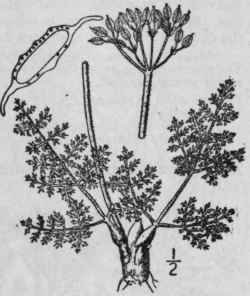
Fig. 3119
Ferula foeniculacea Nutt. Gen. 1: 183. 1818.
Lomatium villosum Raf. Journ. Phys. 89. 101. 1819.
Cogswellia villosa Spreng.; Roem. & Schultes, Syst. 6: 588. 1820.
Cogswellia foeniculacea Coult. & Rose, Contr. U. S. Nat. Herb. 12: 449. 1909
Tomentose-pubescent; peduncles 3'-8' long, exceeding the leaves. Roots long and deep; leaves very finely dissected into narrowly oblong obtuse lobes and segments, the primary divisions mostly ternate; umbel 4-10-rayed, the rays 4"-10" long in fruit; bracts of the involucels lanceolate, tomentose, or finely pubescent, separate or nearly so; flowers yellow; fruit oval, finely pubescent, 3"-3 1/2" long, about 2 1/2" broad, the lateral wings narrower than the carpel, the dorsal and intermediate ribs prominent; oil-tubes 3-4 in the intervals.
Plains and dry soil, North Dakota to Assiniboia, Wyoming, Nebraska and Texas. April-May.
Continue to:


My Books

