


1. Reseda [Tourn.] L. Sp. Pl. 448. 1753
Description
This section is from the book "An Illustrated Flora Of The Northern United States, Canada And The British Possessions Vol2", by Nathaniel Lord Britton, Addison Brown. Also available from Amazon: An Illustrated Flora of the Northern United States, Canada and the British Possessions. 3 Volume Set..
1. Reseda [Tourn.] L. Sp. Pl. 448. 1753
Erect or decumbent herbs, with entire lobed or pinnatifid leaves, and small spicate or narrowly racemose flowers. Petals 4-7, toothed or cleft. Disk cup-shaped, glandular. Stamens 8-40, inserted on one side of the flower and on the inner surface of the disk. Capsule 3-6-lobed, horned, opening at the top before the seeds mature. [Ancient Latin name, referring to the supposed sedative effects of some of the species.]
About 55 species, all natives of the Old World. Type species: Reseda lutea L.
Leaves entire; upper petals lobed, the lower entire. | 1. | R. Luteola. |
Leaves lobed or pinnatifid. | ||
Petals greenish-yellow, 3 or 4 of them divided. | 2. | R. lutea. |
Petals white, all of them cleft or divided. | 3. | R. alba. |
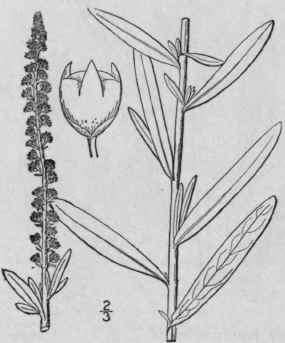
1. Reseda Luteola L. Dyer's Rocket. Yellow-Weed
Fig. 2120
Reseda Luteola L. Sp. Pl. 448. 1753.
Glabrous, erect, simple, or sparingly branched above, \°-2\° high. Leaves lanceolate or linear, entire, obtuse, sessile or the lowest narrowed into a petiole; flowers greenish-yellow, 1"-2" broad, in long narrow spikes; sepals 4; petals 4 or 5, very unequal, the upper ones lobed, the lower one linear, entire; capsule globose, 2."-3" in diameter, with 3 or 4 apical teeth and 6-8 lateral ridges.
In waste places and in ballast, Massachusetts to New York and Pennsylvania. Mexico. Adventive from Europe. Cultivated for its yellow dye. Summer. Dyer's-weed. Dyer's-mignonette. Weld. Yellow or Italian rocket. Dutch pink. Wild woad.
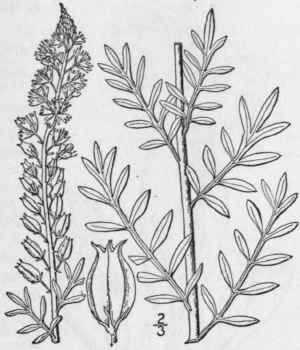
2. Reseda Lùtea L. Yellow Cut-Leaved Mignonette
Fig. 2121
Reseda lutea L. Sp. Pl. 449. 1753.
Ascending or decumbent, pubescent with short scattered stiff hairs, or nearly glabrous. Leaves 2'-4' long, broadly ovate or oblong in outline, deeply lobed or divided, sometimes pinnatifid, their segments linear or oblong, obtuse, the margins undulate; flowers greenish-yellow, 2"-3" broad, in narrow racemes; pedicels ascending, about 2" long in fruit; petals 6 or 5, all but the lowest irregularly cleft; sepals of the same number; stamens 15-20; capsule oblong, about 4" long, 1 1/2"-2" wide, with three or rarely 4 short teeth.
In waste places, Massachusetts to New Jersey, Pennsylvania and Michigan, and in ballast about the seaports. Adventive from Europe. Summer. Called also cramb-ling rocket.
Reseda odoràta L., the mignonette of the gardens, has wedge-shaped entire or 3-lobed leaves, and very fragrant flowers with deeply cleft petals.
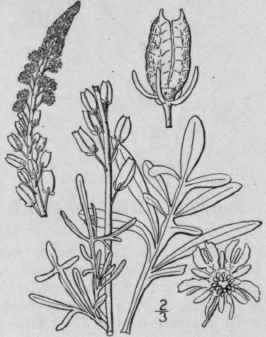
3. Reseda Alba L. White Cut-Leaved Mignonette
Fig. 2122
Reseda alba L. Sp. Pl. 449. 1753.
Erect, glabrous, somewhat glaucous, 1°-3° high. Leaves often crowded, pinnate or deeply pinnatifid, the segments 9-12, linear, linear-oblong or lanceolate, obtusish, entire or undulate, 4"-12" long; flowers nearly white, 2" - 3" broad, in dense spike-like racemes; pedicels short; petals 6 or 5, all 3-cleft at the summit; sepals of the same number; stamens 12-15; capsule ovoid-oblong, usually 4-toothed, 5"-6" long.
In waste places, Connecticut to Pennsylvania and Ohio, in ballast about the eastern seaports and in British Columbia. Adventive from southern Europe. July-Aug.
Continue to:


My Books

