


1. Elatine L. Sp. Pl. 367. 1753
Description
This section is from the book "An Illustrated Flora Of The Northern United States, Canada And The British Possessions Vol2", by Nathaniel Lord Britton, Addison Brown. Also available from Amazon: An Illustrated Flora of the Northern United States, Canada and the British Possessions. 3 Volume Set..
1. Elatine L. Sp. Pl. 367. 1753
Small glabrous or glabrate aquatic or creeping herbs, with opposite or verticillate leaves, and minute axillary mainly solitary flowers. Sepals 2-4, persistent, membranous, not ribbed. Petals of the same number, hypogynous. Stamens of the same number or twice as many. Styles or stigmas 2-4. Pod membranous, globose, 2-4-valved. Seeds 00, straight, or slightly curved, striate longitudinally and transversely. [Greek, fir-like, with reference to the leaves.]
About 10 species, natives of temperate and warm regions. In addition to the following, another occurs in California and one in Montana. Type species: Elatine Hydróbifer L.
Petals and stamens 2; seeds distinctly sculptured. | ||
Leaves obovate; seeds with 9-10 longitudinal and 20-30 transverse striae. | 1. | E. americana. |
Leaves oblong or oval; seeds with 6-7 longitudinal and 10-12 transverse striae. | ||
2. | E. brachyspcrma. | |
Petals and stamens mostly 3; seeds little sculptured. | 3. | E. triandra. |
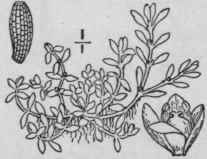
1. Elatine Americàna (Pursh) Arn. Water-Wort. Mud-Purslane
Fig. 2905
Peplis americana Pursh, Fl. Am. Sept. 238. 1814. Elatine americana Arn. Edinb. Journ. Sci. 1: 430. 1830.
Erect or spreading, tufted, aquatic or terrestrial, 1/2'-1/2' long often submerged. Leaves obovate, obtuse, 1"-3" long, 1' wide or less; flowers sessile, axillary, minute, rarely opening in the submerged forms; sepals, petals, stamens and stigmas 2 (rarely 3 in the terrestrial forms); capsule globose, nearly i" in diameter; seeds i" to nearly 1/2" long, slightly curved, marked by 9-10 longitudinal striae and 20-30 cross-bars.
Margins of ponds and slow streams, Quebec to British Columbia, Virginia, Missouri, Texas and Mexico. Summer.
2. Elatine Brachyspérma A. Gray. Short-Seeded Water-Wort
Fig. 2006
Elatine brachysperma A. Gray, Proc. Am. Acad. 13: 361. 1878.
Terrestrial or sometimes submerged, spreading, tufted, 1'-2' long. Leaves oblong, oval or lanceolate, narrowed at the base, 2"-3" long, about 1" wide, obtuse; flowers sessile, axillary, minute; sepals, petals, stamens and stigmas mainly 2; capsule nearly as in the preceding species; seeds short-oblong, nearly straight, about \" long, marked by 6-7 longitudinal striae and 10-12 cross-bars.
Margins of ponds, Illinois and California, doubtless occurring between these limits. Summer.

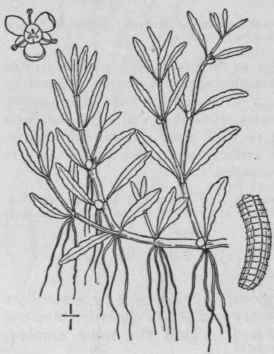
3. Elatine Triándra Schk. Long-Stemmed Water-Wort
Fig. 2907
Elatine triandra Schk. Bot. Hand, 1: 345. 1791.
Flaccid, tufted, immersed or creeping, stems 2'-4' long, much branched. Leaves oblong or oblanceo-late, very thin, obtuse, 2"-4" long, 1" wide, narrowed at the base; flowers minute, axillary, sessile; sepals commonly 2; petals, stamens and stigmas 3; seeds slightly curved, about the size of those of E. americana, slightly marked longitudinally and transversely.
Ponds, Illinois, South Dakota and Nebraska to Washington. Also in Europe. Summer.
2. BÈRGIA L. Mant. 1: 152, 241. 1771.
Herbs, or somewhat shrubby plants, branching, erect, ascending or prostrate, more or less pubescent, with opposite serrate or entire leaves, and small axillary solitary or clustered flowers. Parts of the flowers in 5's (very rarely in 4's or 3's). Sepals acute. Pod crus-taceous, ovoid, 5-valved. Seeds numerous, striate longitudinally and transversely. [In honor of Dr. P. J. Bergius, 1723-1790, professor of Natural History in Stockholm.]
About 15 species, natives of warm and temperate regions. Type species: Bergia capensis L.
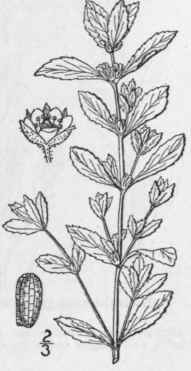
1. Bergia Texàna (Hook.) Seub. Texas Bergia
Fig. 2908
Merimea texana Hook. Icon. Pl. pl. 278. 1840.
Bergia texana Seub.; Walp. Rep. 1: 285. 1842.
Prostrate or ascending, diffusely branched, pubescent, stems 6-10' long. Leaves spatulate or obovate, 1'-1 1/2' long, 6"-8" wide, acutish or obtuse, serrate, narrowed into a short petiole; stipules scarious, about 1" long, ciliate-serrulate; flowers very short-peduncled, about 1 1/2" broad, solitary or 2-3 together in the axils; sepals ovate, acuminate, denticulate, slightly longer than the oblong obtuse petals; capsule globose, 1" in diameter, its dehiscence septifragal; seeds oblong, striate longitudinally and cross-barred.
Southern Illinois to Texas, west to Nevada and California. Summer.
Continue to:


My Books

