


1. Cyrílla Garden; L. Mant. 1: 5, 50. 1767
Description
This section is from the book "An Illustrated Flora Of The Northern United States, Canada And The British Possessions Vol2", by Nathaniel Lord Britton, Addison Brown. Also available from Amazon: An Illustrated Flora of the Northern United States, Canada and the British Possessions. 3 Volume Set..
1. Cyrílla Garden; L. Mant. 1: 5, 50. 1767
Racemes clustered at the ends of twigs of the preceding season. Sepals 5, firm, acute, shorter than the petals. Petals 5, white, acute, spreading. Stamens 5, opposite the sepals, the filaments subulate, the anthers oval. Ovary ovoid, sessile, mostly 2-celled, sometimes 3-celled; ovules 2-4 in each cavity; style short, thick, 2-3 lobed. Fruit ovoid, 2-3-seeded, the pericarp spongy. [in honor of Domenico Cyrillo, professor of medicine at Naples.]
Three or four species, natives of southeastern North America, the West Indies and northern South America, the following the generic type.
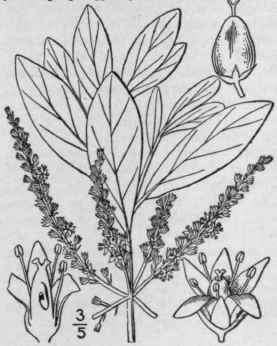
1. Cyrilla Racemiflòra L. Southern Leather-Wood Or Ironwood
Fig. 2785
Cyrilla racemiflora L. Mant. 1: 50. 1867.
A shrub or small tree, sometimes 350 high and the trunk 15' in diameter, the bark at the base spongy. Leaves oblanceolate, obovate or oval, short-petioled, reticulate-veined and the midvein rather prominent beneath, obtuse or acute at the apex, cuneate-narrowed at the base, 2'-4' long, 3' - 1' wide; racemes narrow, 2'-6' long, bearing the very numerous small white flowers nearly to the base; pedicels 1"-2" long, somewhat longer than the bracts, or shorter; fruit about 1" long.
Along streams and swamps, southern Virginia to Florida and Texas, mostly near the coast. Also in the West Indies and South America. He-huckleberry. Burn-wood bark. White or red titi. May-July.
Continue to:


My Books

