


Persicaria (Tourn.) Mill. Gard. Dict. Abr. Part 4
Description
This section is from the book "An Illustrated Flora Of The Northern United States, Canada And The British Possessions Vol1", by Nathaniel Lord Britton, Addison Brown. Also available from Amazon: An Illustrated Flora of the Northern United States, Canada and the British Possessions. 3 Volume Set..
Persicaria (Tourn.) Mill. Gard. Dict. Abr. Part 4
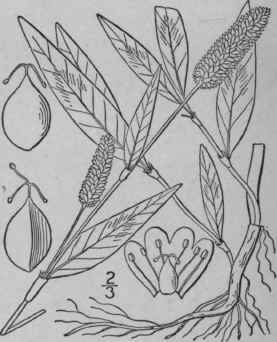
7. Persicaria Careyi (Olney) Greene. Carey's Persicaria
Fig. 1636
Polygonum Careyi Olney, Proc. Providence Franklin
Soc. 1: 29. 1847. Persicaria Careyi Greene, Leaflets 1: 24. 1904.
Annual, rough-glandular throughout, stem erect, 1°-3° tall, simple or sparingly branched above. Leaves oblong-lanceolate or linear-lanceolate, the uppermost nearly linear, 2'-11' long, short-petioled the midrib, ciliate, sparingly punctate; ocreae cylin-or nearly sessile, acuminate at both ends, hispid on dric, sparsely hispid, fringed with long bristles; racemes several, narrow, terminal, loosely-flowered, drooping, 1'-2 1/2' long; calyx purplish; stamens 5 or sometimes 8; style 2-par"ted to below the middle; achene lenticular, broadly ovoid or obovoid, 11 /4'-1 1/2" long, short-pointed, thick, smooth and shining.
In marshes, Maine and Ontario to Rhode Island, New Jersey, Delaware and Pennsylvania. Ascends to 2000 ft. in Pennsylvania. Also in Michigan. July-Sept.
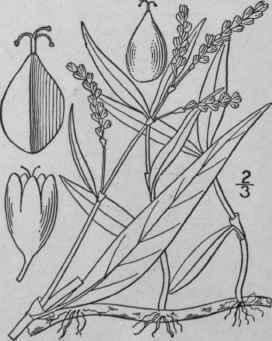
8. Persicaria Persicaria (L.) Small. Lady's Thumb. Heartweed
Fig. 1637
Polygonum Persicaria L. Sp. PI. 361. 1753. Persicaria Persicaria Small, Fl. SE. U. S. 378. 1903.
Annual, glabrous or puberulent; stem erect or ascending, simple or much branched, 1/2°-2° high. Leaves lanceolate or linear-lanceolate, 1'-6' long, shorf-petioled or nearly sessile, acuminate at both ends, conspicuously punctate, usually with a dark triangular or lunar blotch near the centre, their margins entire or slightly eroded, often ciliate; ocreae cylindric, nearly glabrous, fringed with short bristles; racemes solitary or panicled, i'-2' long, ovoid or oblong, dense, erect; calyx pink or dark purple; stamens mostly 6; style 2-3-parted to below the middle; achene broadly ovate and lenticular, often gibbous or 3-angled, 1"-1 1/4" long, smooth and shining.
In waste places, throughout North America, except the extreme north. Naturalized from Europe. Often an abundant weed. Common persicary. Spotted-knotweed. Red- or pink-weed. Heartsease. Peach-wort. Willow-weed. Red-shanks. Lover's-pride. Black-heart. June-Oct.
9. Persicaria Persicarioides (H.B.K.) Small. Southwestern Persicaria
Fig. 1638
Polygonum persicarioides H.B.K. Nov. Gen. 2: 179.
1817. Persicaria persicarioides Small, Fl. SE. U. S. 378. 1903.
Perennial, glabrous or minutely pubescent; stem erect, decumbent or creeping, simple or branched, 1°-3° long. Leaves lanceolate or linear-lanceolate, acuminate at both ends, punctate, short-petioled or subsessile, 1 1/2'-10' long; ocreae cylindric, glabrous or sparingly strigillose, fringed with short bristles: spicate racemes more or less panicled, erect, l'-3' long, narrowly oblong or linear, loosely-flowered; calyx rose-color tinged with green, 5-parted to below the middle; stamens 8 or fewer, included; style 2-3-parted to near the base; achene lenticular and biconvex, or 3-angled, more or less gibbous, 1" long, ovoid or broadly oblong, short-pointed, black, minutely granular, but shining.
Nebraska to Mexico; widely distributed in tropical America. June-Sept.
Continue to:


My Books

