


Black-eyed Susan; Yellow or Ox-eye Daisy; Nigger-head; Golden Jerusalem; Purple Cone-flower

Description
This section of the book is from the "Wild Flowers Worth Knowing" book, by Neltje Blanchan. Also available from Amazon: Wild Flowers Worth Knowing
Black-eyed Susan; Yellow or Ox-eye Daisy; Nigger-head; Golden Jerusalem; Purple Cone-flower
COMPOSITE FAMILY - Compositae: Black-eyed Susan; Yellow or Ox-eye Daisy; Nigger-head; Golden Jerusalem; Purple Cone-flower
Rudbeckia hirta
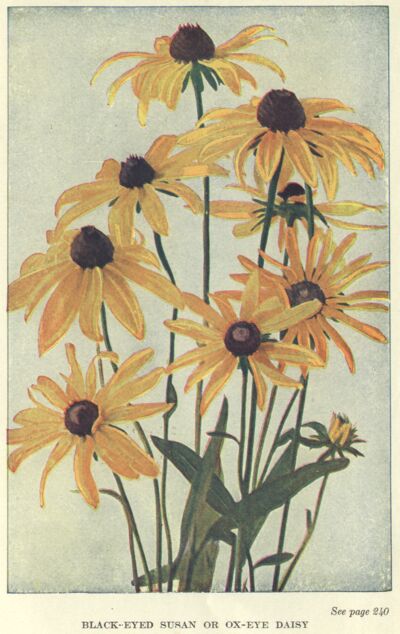
Flower-heads--From 10 to 20 orange-yellow neutral rays around a conical, dark purplish-brown disk of florets containing both stamens and pistil. Stem: 1 to 3 ft. tall, hairy, rough, usually unbranched, often tufted. Leaves: Oblong to lance-shaped, thick, sparingly notched, rough.
Preferred Habitat--Open sunny places; dry fields.
Flowering Season--May-September.
Distribution--Ontario and the Northwest Territory south to Colorado and the Gulf states.
So very many weeds having come to our Eastern shores from Europe, and
marched farther and farther west year by year, it is but fair that
black-eyed Susan, a native of Western clover fields, should travel
toward the Atlantic in bundles of hay whenever she gets the chance, to
repay Eastern farmers in their own coin. Do these gorgeous heads know
that all our showy rudbeckias--some with orange red at the base of
their ray florets--have become prime favorites of late years in
European gardens, so offering them still another chance to overrun the
Old World, to which so much American hay is shipped? Thrifty farmers
may decry the importation into their mowing lots, but there is a glory
to the cone-flower beside which the glitter of a gold coin fades into
paltry nothingness. Having been instructed in the decorative
usefulness of all this genus by European landscape gardeners, we
Americans now importune the Department of Agriculture for seeds
through members of Congress, even Representatives of States that have
passed stringent laws against the dissemination of "weeds." Inasmuch
as each black-eyed Susan puts into daily operation the business
methods of the white daisy, methods which have become a sort of creed
for the entire composite horde to live by, it is plain that she may
defy both farmers and legislators. Bees, wasps, flies butterflies, and
beetles could not be kept away from an entertainer so generous; for
while the nectar in the deep, tubular brown florets may be drained
only by long, slender tongues, pollen is accessible to all. Any one
who has had a jar of these yellow daisies standing on a polished table
indoors, and tried to keep its surface free from a ring of golden dust
around the flowers, knows how abundant their pollen is. The black-eyed
Susan, like the English sparrow, has come to stay--let farmers and
law-makers do what they will.
Continue to:
Books by Neltje Blanchan:


My Books

