


Registered Bonds
Description
This section is from the "Why Bonds Are Safe Investments" book, by Harris Trust & Savings Bank. Also see Amazon: Why Bonds Are Safe Investments.
Registered Bonds
Some bonds do not have coupons; these are known as "fully registered bonds." Instead of presenting coupons for collection, the owner of such bonds receives his interest by check through the mail without action on his part. To "register" a bond the owner has it sent to the agent of the maker of the bond so that he may be recorded as the owner of the bond. Bonds may be registered in two ways. In the case of a "fully registered" bond both principal and interest are payable only to the person who has been recorded as its owner. Thus, a "fully registered" bond may be said to be "registered as to principal and interest." When, however, a bond is "registered as to principal only," it carries interest coupons, which are collected in the usual way. A bond, the principal of which is registered, must be transferred on the books of the maker's agent each time it is sold; that is, only the registered owner can sell it legally. Coupon bonds can be sold without this formality. The chief value of the registered form of bond is that it safeguards the bondholder against loss in case the bond is mislaid or stolen. If the purchaser expects to sell his bond on short notice, it is preferable to buy the coupon form instead of the registered form, for the coupon bond can be delivered at once without the delay sometimes necessary in transferring the registered bond.
Maturity
We have said that on the face of the bond is printed the date it will fall due, or be paid off. This date is its maturity. Many bonds are paid off at a stated date, without any privilege of payment at an earlier time. Such bonds may run for any period specified, but it is customary for them to run three, five, ten, twenty, thirty, forty, fifty years or even longer. Some bonds, however, may be paid off at the option of the borrowers at an earlier date, frequently at a premium. Thus a 31000 bond with a maturity of twenty years from date of issue may, by such provision, be retired by the borrower in ten years at 105 or by the payment of $1050 instead of $1000 to the holder.
Interest
The rate of interest to be paid is stated in the bond, and also the time when the interest will fall due, whether every three months, every six months, or yearly. This rate is paid until the bond matures or is redeemed under its optional provision. The usual interest payment is twice a year; thus the owner of a bond bearing six per cent interest payable semi-annually January 1 and July 1 will receive on each of those dates a half-year's interest on his bond; if the denomination of the bond is $1,000, that is $1,000 face value, he will receive $ 30 on January 1 and $30 on July 1.
Since interest is always accruing on bonds at the rate named therein, one must consider, when bonds are sold, the amount of interest that has been earned between the time the last previous coupon matured and the date the bonds are to change hands. Naturally the seller of the bonds is entitled to the interest the bonds have earned while they were his; hence he charges the buyer with this "accrued interest." From this practice arises the term "and interest," or "accrued interest" in connection with the market price of a bond. The price of a bond, therefore, is usually quoted thus: "97½ and interest." This means that a $100 bond is to be sold at $97.50 plus whatever interest has been earned since the last coupon was paid; or that a $1,000 bond will be sold at $97.5 and interest. To cite an example: Suppose interest on a certain $1,000 bond is payable January 1 and July 1 at the rate of five per cent yearly, and the bond is to be sold October 1; it is evident that a coupon calling for $25 was paid July 1, but that the next coupon to be paid January 1 has earned half the $25 to be paid next January. In other words, $12.50 has accrued to the date of sale. Therefore, if the bond is to be sold at 97½ and interest, the price will be $975 plus the $12.50 accrued interest, or $ 987.50. Thus the seller gets his accrued interest on his bond when he sells it, and the buyer gets back the interest thus advanced when the coupon matures in January.
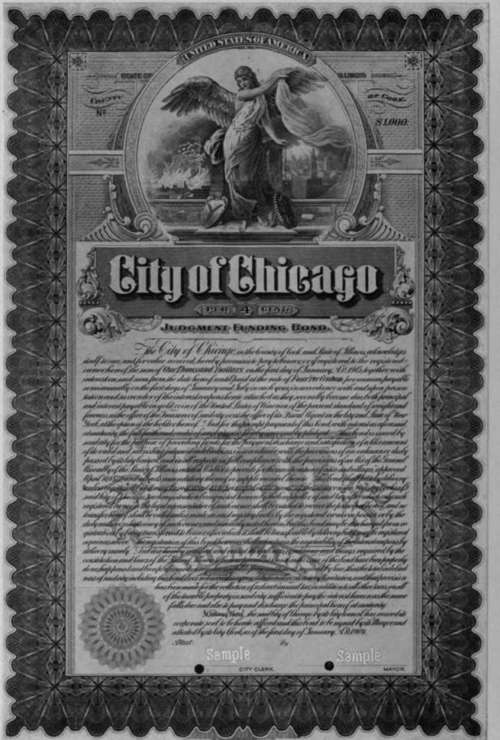
Specimen Copy Of City Of Chicago Bond.
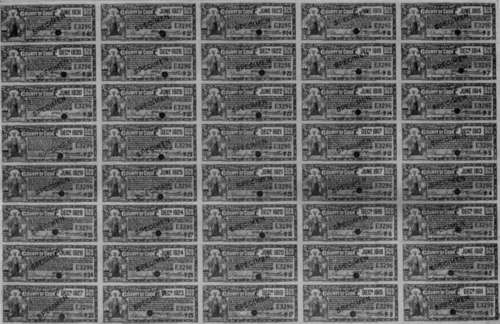
Specimen Of Coupons From Cook County, Illinois, Bond.
Continue to:


My Books

