


Magnetism In Its Relation To Induced Electromotive Force And Current. Part 4
Description
This section is from "Scientific American Supplement". Also available from Amazon: Scientific American Reference Book.
Magnetism In Its Relation To Induced Electromotive Force And Current. Part 4
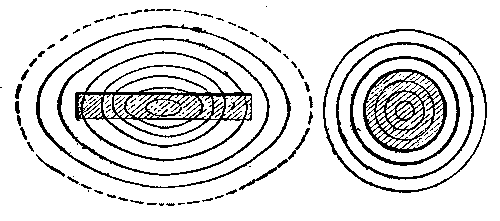
Fig. 2.

Fig. 3.
The moment we begin the bringing of iron into proximity with an electric conductor conveying current, we provide a better medium for the flow or development of magnetic lines or circuits. In other words, the lines may then be longer, yet equally intense, or more lines may be crowded into a section of this metal than in air or space. Figs. 4a, 4b, 4c show the effect brought about by bringing iron of different forms near to the conductor.

Figs. 4.
It shows, in other words, the development of the ordinary electro-magnet of the horseshoe form, and the concentration of the lines in the better medium. The lines also tend to shorten and diminish the resistance to their passage, so that attraction of the iron to the conductor takes place, and if there is more than one piece of iron, they tend to string themselves around the conductor in magnetic contact with one another.
When copper bars of 1 inch diameter are traversed by currents of 40,000 to 60,000 amperes, as in welding them, the magnetic forces just referred to become so enormous that very heavy masses of iron brought up to the bar are firmly held, even though the current be of an alternating character, changing direction many times a second.
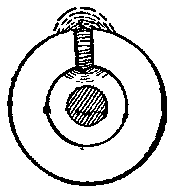 Fig. 5.
When a conductor is surrounded by a cast iron ring, as in Fig. 5, the current in such conductor has an excellent magnetic medium surrounding it. A large amount of energy is then abstracted on the first impulse of current, which goes to develop strong and dense magnetic lines through the iron ring and across the gap in it. On taking off the current the energy is returned as extra current, and its force is many times what would be found with air alone surrounding the conductor. We have then greatly increased the self-induction, the storing of energy and opposition to current flow at the beginning, the giving back of energy and assistance to the current flow on attempting to remove or stop the current. Let us now complete the ring, by making it of iron, endless, Fig. 6, with the conductor in the middle.
 Fig. 6.
We now find that on passing current through the conductor it meets with a very strong opposing effect or counter potential. The evolution of magnetic lines, or the opening out of magnetic circuits, goes on at a very rapid rate. Each line or magnetic circuit evolved, and cutting the conductor, flies at once outward, and locates itself in the iron ring. This ring can carry innumerable lines, and they do not crowd one another. It permits the lines even to lengthen in reaching it, and yet, on account of its low resistance to their passage, the lengthening is equivalent to their having shortened in other media. We will suppose the current not sufficient to exhaust this peculiar capacity for lines which the iron has. Equilibrium is reached, the conductor has opened up innumerable closed circuits, and caused them to exist in the ring still closed; but in iron, not space or ether merely. The current passing has continued its action and storage of energy until to emit another line in view of the resistance now found in the crowded iron ring is impossible.
Now let us cut off the current. We are surprised to find a very weak extra current, a practical absence of self-induction on breaking, or, at least, a giving out of energy in nowise comparable to that on making. Let us put on the current as it was before. Another curious result. But little self-induction now on making energy not absorbed.
Now cut off the current again. Same effect as before. Now let us put on the current reversed in direction. At once we find a very strong counter potential or opposing self-induction developed.
The ring had been polarized, or retained its magnetic energy, and we are now taking out one set of lines and putting in reversely polarized lines of force. This done, we break the reversed current without much effect of self-induction. The ring remains polarized and inert until an opposite flow of current be sent through. Iron is then a different medium from the ether.
The ring once magnetized must, in losing its magnetism, permit a closure of the lines by shortening. This involves their passage from the iron across the space in the center of the ring, notwithstanding its great resistance to the lines of force. As passage from iron to air is equivalent to lengthening of the lines, it is readily seen that such lengthening may oppose more effect than a slight shortening due to leaving iron, for air or space may give in provoking a closure and disappearance of the lines. Looked at from another standpoint, the lines on the iron may actually require a small amount of initial energy to dislodge them therefrom, so that after being dislodged they may collapse and yield whatever energy they represent.
I must reserve for the future further consideration of the iron ring, but in thinking upon this matter I am led to think that the production of a magnetic line in an iron ring around a conductor may represent a sort of wave of energy, an absorption of energy on the evolution of the line from the conductor, and a slight giving out of energy on the line reaching that position of proximity to the iron ring, that its passage thereto may be said to be a shortening process or a lessening of its resistance.
Continue to:


My Books

