


The Kravogl Electric Motor. Continued
Description
This section is from "Scientific American Supplement". Also available from Amazon: Scientific American Reference Book.
The Kravogl Electric Motor. Continued
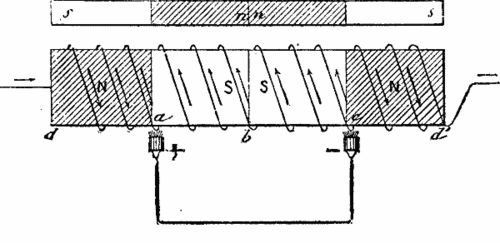
FIG. 1.
In the presence of the historic interest that attaches to the question, we do not think it will be out of place to reproduce here the considerations that guided Prof. Pfaundler in the researches that led him to convert the Kravogl motor into a dynamo-electric machine. Let us consider two magnetized bars, db and bd', placed end to end and surrounded by a cylindrical armature forming a shell, this armature being likewise supposed to be a permanent magnet and to present poles of contrary direction opposite the poles of the bars. For the sake of greater simplicity this shell is represented by a part only in the figure, s n n s. If, into a magnetic field thus formed, we pass a spiral from left to right, the spiral will be traversed by a current whose direction will change according to the way in which the moving is done. It is only necessary to apply Lenz's law to see that a reversal of the currents will occur at the points, a and c, the direction of the current being represented by arrows in the figure. If we suppose a continual displacement of the spirals from left to right, we shall collect a continuous current by placing two rubbers at a and c. Either the core or the shell may be replaced by a piece of soft iron.
In such a case this piece will move with the spiral and keep its poles that are developed by induction fixed in space. From this, in order to reach a dynamo-electric machine it is necessary to try to develop the energy of the magnetic field by the action of the current itself. If we suppose the core to be of soft iron, and make a closer study of the action of the current as regards the polarity that occurs under the influence of the poles, s, n, s, we shall see that from d to a and from b to c the current is contrary, while that from a to b and from c to d' it is favorable to the development of such polarity. In short, with a spiral moving from d to d' the resulting effect is nil, a fact, moreover, that is self-evident. Under such circumstances, if we suppose the shell, as well as the core, to be of soft iron, we shall obtain a feeble current due to the presence of remanent magnetism; but this magnetism will not be able to continue increasing under the influence of the current. To solve this difficulty two means present themselves: (1) to cause a, favorable magnetic current and act upon the armature, and (2) to suppress such portions of the current in the spirals as are injurious in effect.
The first solution was thought of by Gramme in 1871, and is represented diagramatically in Fig. 2. The second is due to Prof. Pfaundler, and dates back to 1870. The core is cut through the center (Fig. 3), and the portion to the right is suppressed; the current is interrupted between da and cd', and is closed only between a and c (v, Fig. 1). It results from this arrangement that, under the action of the current, the polarity due to remanent magnetism does nothing but increase. It suffices then for but little remanent magnetism to prime the machine; the polarity of the shell continues to increase, and the energy of the magnetic field, and consequently of the current, has for a limit only the saturation of the soft iron. If, now, we curve the core, the spirals, and the armature into a circle, we have a Gramme or a Pfaundler machine, according as we consider Fig. 2 or Fig. 3.
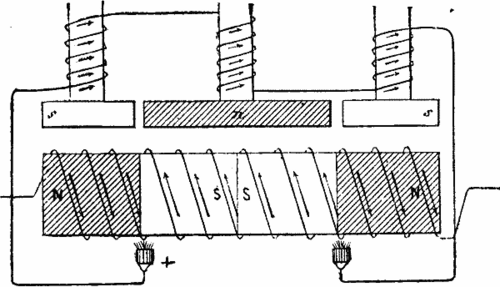
FIG. 2.
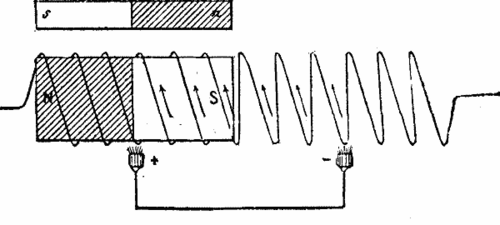
FIG. 3.
This latter apparatus has in this case the form shown in Fig. 4.
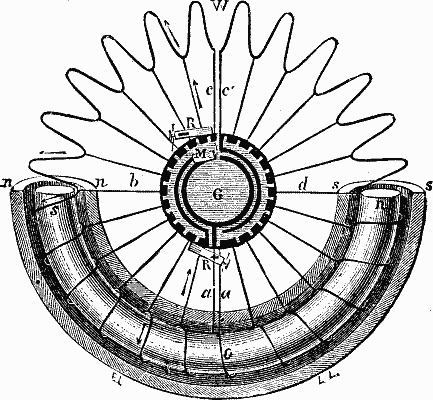
FIG. 4.
The spiral, s m b, is movable, and the core, N o s, is kept in a position of equilibrium by virtue of its weight, and is provided with rollers. For the sake of greater clearness, the front part of the armature is supposed to be removed. The current does not circulate in the spirals to the right of the diameter, W O, which latter is not absolutely vertical. The position of the rubbers and armature is regulated once for all. We do not know just what were the means devised by Kravogl to suppress the current in the spheres to the right. At all events, it is probable that the system has grown old since Gramme invented his collector. In the application of the Kravogl motor to the generation of continuous currents, Professor Pfaundler now proposes to ingeniously utilize the Gramme collector. In such a case the arrangement shown in Fig. 5 would be adopted. Let us suppose an ordinary collector having as many plates as there are sections in the ring, these plates being connected as usual with the entrance and exit wires of the sections. The diametrically opposite touches that are in the line, W O, are divided, and one of the halves is connected at the entrance, c a' (Fig. 4), with the corresponding section, while the other communicates with the exit, c' a, of the neighboring section.
Each of these halves is prolonged by a piece of metal bent into the form of an arc of a circle and embracing a little less than a semi-circumference. Between these prolongations there is an insulating part. In the rotary motion of the spiral, at least one of the touches is always outside of the arc comprised between the brushes, R. In order to secure a continuity of the circuit in the effective arc, W S o, it is only necessary to arrange a rubber, M, in such a way as to establish a communication between the two parts of the divided touch as soon as this latter enters the arc under consideration.
In order to produce a current in the direction of the arrows shown in Fig. 4, the spiral and axle must revolve from right to left. In this case the rubber, M, occupies the position shown in the same figure, the brushes embracing an arc of a little less than 180°. As soon as the lower touch comes in contact with the brush, R, when the revolution is being effected from left to right, the rubber, M, establishes a communication between the two halves that have until now been isolated, and the current is no longer interrupted. The second touch during this time is at any point whatever of the arc, W N o, and the spirals corresponding to the latter arc outside of the circuit. In short, thanks to the rubber, M, we have an ordinary Gramme collector in that portion of the circuit comprised between the brushes, and a collector with a breakage of the circuit in the portion to the right.
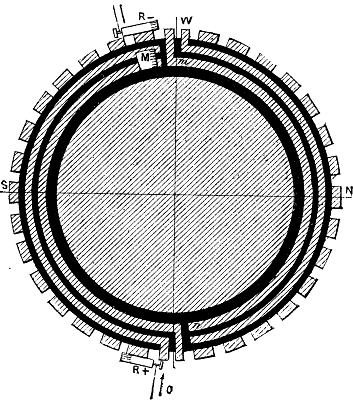
FIG. 5.
This type of machine is entirely theoretical. In the apparatus used for Prof. Pfaundler's experiments in 1870, the armature revolved with the solenoid. The core and armature were of soft iron, and the core was arranged in a manner analogous to the preceding, and remained in place under the action of its weight, and the shell, forming a complete circle, revolved with poles fixed in space.
Practically, the machine that we have just described would prove inconvenient to realize, and would present serious inconveniences. In the first place, it seems to us quite difficult to transmit the motion of the solenoid to the axle, supposing the former to revolve within the armature. In the second place, considerable friction would surely occur between the spirals and core, and the axle, being submitted to a lateral stress, would be placed in a poor condition for work. It is even allowable to doubt whether such a type could be practically got up. At all events, no trial has as yet been made of it.
Compared with the Gramme machine, from an absolutely theoretical point of view, the Pfaundler apparatus presents undoubted advantages. A theoretically perfect dynamo electric machine would be one in which there was a complete reciprocity between the magnetizing action of the current and the inductive action of the magnetic field. Now, such is not the case in the Gramme machine. In this apparatus the soft iron core is at the same time a magnet through favorable induction and a disadvantageous electro-magnet. This double polarization is only remedied to a certain extent by the adjustment of the brushes. In the Pfaundler machine, on the contrary, the electro-magnetism and magnetism through induction act in the same direction, and concur in effecting a polarization that favors the production of the current. Looked at it in this light, the latter machine more nearly approaches the type of perfection than does that of Gramme.
But we must not forget that such qualities are purely theoretical. In practice the best machine is that in which the copper is best utilized, that is to say, that which with a given weight of this metal furnishes the most work. Now, this is certainly not the case in the Pfaundler machine, for here half or more than half of the ring is inert - a defect which is apparent at first sight. It results from this that as soon as we propose to obtain an electromotive force, however slight it be, we must get it with machines of large dimensions. Now, it is permissible to believe that under such circumstances (taking into consideration the complication of mechanical means that the construction of such apparatus necessitates, and the great friction that occurs) it would be impossible to obtain practical rotary velocities. Comparing his machine with Gramme's, Prof. Pfaundler expresses the idea that between them there is the same analogy as there is between a constant pressure and an expansion engine. With cylinders of equal diameters the work performed by the former of these is greater than that done by the second, but in the latter the expansive force of the steam is better utilized. This comparison seems to us to be more ingenious than exact.
Would it not be coming nearer to the truth if we were to suppose a case of a hydraulic motor whose performance continued diminishing with the height of the fall, and would it not be advantageous under such circumstances to utilize only a portion of the fall for the purpose of increasing the motor's performance?
This machine, however, as before stated, has never as yet been constructed, so that experimental data relative to its mode of working are wanting. It is especially interesting as regards its origin, which dates back to an epoch at which researches on the dynamo electric machine were at their heat. It is in its historical aspect that it is proper to regard it, and it is from such a point of view that we have deemed it well to say a few words about it in this place. - La Lumiere Electrique.
[1]
Zeitschrift des Electrotechnischen Vereines in Wien, July, 1883.
Continue to:


My Books

