


Practical Notes On Plumbing. Part 5
Description
This section is from "Scientific American Supplement Volumes 275, 286, 288, 299, 303, 312, 315, 324, 344 and 358". Also available from Amazon: Scientific American Reference Book.
Practical Notes On Plumbing. Part 5
Pulling Up Bends
In London, it is the favorite plan to make bends without cutting them. Fig. 46. It is done by taking a length of pipe, and, just where you require the bend, lay it (with the seam at the side) upon a pillow, made by tightly filling a sack with sand, wood shavings, or sawdust; have some shavings ready to hand and a good lath, also a short length of mandrel about 3 ft. long and about ½ in. smaller than the pipe, and a dummy as shown at A B, Fig. 56. Now, all being ready, put a few burning shavings into the throat of the bend, just to get heat enough to make it fizz, which you can judge by spitting on it. When this heat is acquired withdraw the fire, and let the laborer quickly place the end of the mandrel into the pipe, and pull the pipe up while you place a sack or anything else convenient across the throat of the bend, then pull the pipe up a little, just sufficient to dent it across the throat. Now, with a hot dummy, dummy out the dent, until it is round like the other part of the pipe. Keep at this until your bend is made, occasionally turning the pipe or its side and giving it a sharp blow on the side with the soft or hornbeam dresser; this is when the sides run out as in Fig. 37. Never strike the back part of the bend from inside with the dummy, but work the lead from the throat to the back with a view to thickening the back.

FIG. 46.
Set-Offs
A set-off is nothing more than a double bend, as shown at Fig. 47, and made in much the same manner. D is the long end of the pipe. Always make this bend first and pull it up quite square, as it will be found to go a little back when pulling up the other bend; if you can make the two together so much the better, as you can then work the stuff from the throat of one bend into the back of the other. The different shaped dummies are also here shown: F a round-nosed dummy, G a double bent dummy, H a single bent, I straight, J hand-dummy, ABN a long bent dummy shown at Fig. 38.

FIG. 47.
Bad Bends
These can always be detected by examining them in their backs, as at Fig. 48; take a small dresser and tap the pipe a few times round ABD to test for the thickness. Strike it hard enough to just dent it; next strike the back part of the pipe, E, with the same force, and if it dents much more it is not an equally-made bend. I have seen some of these much-praised London-made bends that could be easily squeezed together by the pressure of the thumb and finger. N.B. - Care must be taken not to reduce or enlarge the size of the bore at the bend.
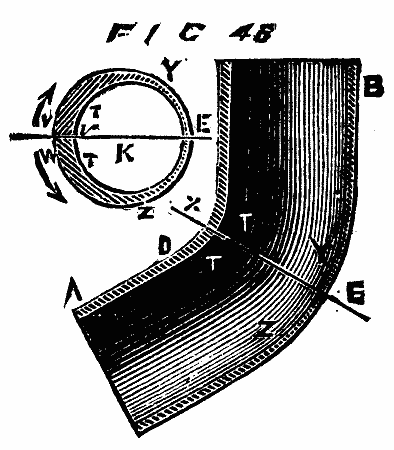
FIG. 48.
Bad Falls In Bends
The fall given in bending lead pipes should be considered of quite as much importance as making the bends of equal thickness especially for pipes, as shown in Fig. 49. In this Fig. you have a drawing of a bad bend. From A to B there is no fall whatever, as also from B to C; such bending is frequently done and fixed in and about London, which is not only more work for the plumber, but next to useless for soil-pipes. Fig. 50 shows how this bend should be made with a good fall from A to J, also from M to N; the method of making these bends requires no further explanation. R, P, and K are the turnpins for opening the ends, the method of which will be explained in a future paragraph on "Preparing for Fixing."

FIG. 49.
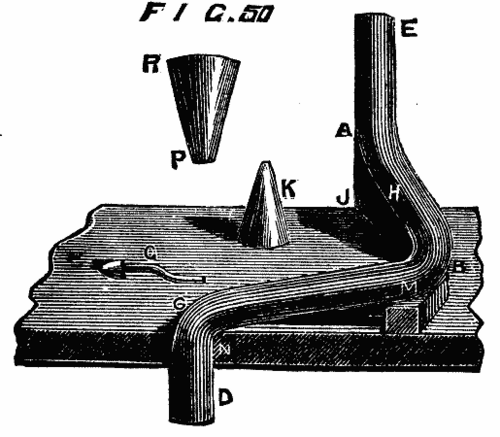
FIG. 50.
Continue to:


My Books

