


Correspondence. The Gary Motor
Description
This section is from "Scientific American Vol. XL. No. 13. March 29, 1879", by Munn & Co. Also available from Amazon: Scientific American Science Desk Reference.
Correspondence. The Gary Motor
To the Editor of the Scientific American:

In your article on the "Gary Motor," issue of March 8, page 144, you say: "There is no neutral line in the sense that polarity changes when Mr. Gary moves his piece of sheet iron with its attached shingle nail across the pole or near the pole of a magnet." "The most delicate instruments fail to detect such a change of polarity," etc. Mr. Gary's claim of a neutral line is of course absurd, but you are wrong in saying that the polarity does not change under the conditions described in theHarper's Monthlyarticle. Mr. Gary is perfectly correct in claiming a change of polarity in that experiment, although his other claim of deriving from this change of polarity a continuous motion without consuming energy are manifestly absurd.
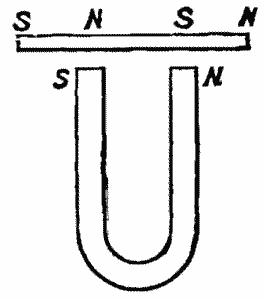
The change of polarity is easily explained. If a bar of soft iron, whose length is two or three times the distance between the poles of the horseshoe magnet, be placed in front of the latter as in the sketch, and at some distance, poles will be induced, as shown by the letters N S. Now let the bar approach the magnet. When within a short distance consequent points will be formed and the polarity at the ends will be reversed, the bar having four poles, as in the second sketch. The bar of soft iron must have certain dimensions depending on the size and power of the horseshoe magnet. By using a powerful electro-magnet in place of a permanent one, a soft iron bar of considerable size may be used, and the change of polarity exhibited by showing the repulsion in one case for the south pole and in the other for the north pole of a heavy permanent magnet. When in the proper position a very small movement of the soft iron bar is sufficient to produce the change.
Wm. A. Anthony.
Cornell University, Ithaca, N. Y., March 2, 1879.
Continue to:


My Books

