


Belgium Army
Description
This section is from the book "Scientific American Reference Book. A Manual for the Office, Household and Shop", by Albert A. Hopkins, A. Russell Bond. Also available from Amazon: Scientific American Reference Book.
Belgium Army
The Belgian army was recently reorganized as the outcome of a popular agitation, leading to the appointment of a mixed commission which prepared a scheme. The main feature was the adoption of volunteer enlistment, with the purpose of bringing about a progressive decrease in the annular levy by subscription. Special advantages were offered, but the result has been very disappointing.
The establishment on Oct. 1st, 1903, when the recruits were embodied, was 42,000 men, but there was a deficiency of 7,000, owing to substitutes not having been found for men who had been absolved from service. The regiments were in some places so weak that training was impossible. The nominal liability is eight years with the colors and five in the reserve, and the recruit contingent is 13,300, the volunteers being in addition.
The composition is as follows: Cavalry - 2 regiments of chasseurs, 2 of guides, and 4 of lancers. Each regiment consists of 4 squadrons active and 1 reserve. To the above have to be added the gendarmerie (over 1,700 men). Artillery - 4 field and 4 fortress regiments (in all 204 guns). Engineers - 1 regiment of 3 battalions, a reserve battalion, and 5 special technical companies. Infantry - 14 regiments of the line, of 4 battalions of 4 companies each, 3 active and 1 reserve battalion; 1 regiment of grenadiers, similarly organized; 1 regiment of carbineers of 6 battalions (4 active and 2 reserve), and 3 regiments of chasseurs-a-pied.
Copyright, 1904, by Munn & Co.
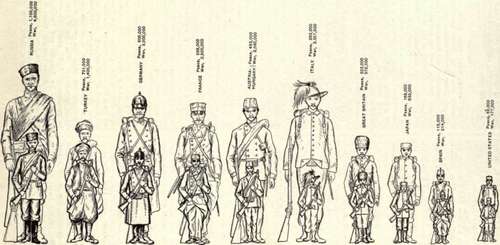
Peace And War Footing Of The Armies Of The World.
The Civic or National Guard is under the Minister of the Interior in peace time, and numbers approximately 45,000 men reckoned as "active," and 100,000 "non-active." The effect of the new law cannot yet be estimated fully.
Continue to:


My Books

