


Horse-Power Transmitted By A Leather Belt One Inch Wide
Description
This section is from the book "Wrinkles And Recipes, Compiled From The Scientific American", by Park Benjamin. Also available from Amazon: Wrinkles and Recipes, Compiled From The Scientific American.
Horse-Power Transmitted By A Leather Belt One Inch Wide
SPEED OF BELT IN FEET PER MINUTE | Horse-power transmitted for arc of contact of | |||||||||||
10° | 20 | 30° | 40° | 50° | 60° | 70° | 80° | 90° | 100° | 110° | 120° | |
100 | 0.014 | 0.028 | 0.040 | 0.052 | 0.062 | 0.072 | 0.082 | 0.090 | 0.098 | 0.106 | 0.112 | 0.119 |
200 | 0.029 | 0.056 | 0.080 | 0.103 | 0.125 | 0.145 | 0.163 | 0.180 | 0.196 | 0.211 | 0.225 | 0.237 |
300 | 0.043 | 0.083 | 0.120 | 0.155 | 0.187 | 0.217 | 0.245 | 0.270 | 0.294 | 0.316 | 0.337 | 0.356 |
400 | 0.058 | 0.111 | 0.161 | 0.207 | 0.249 | 0.289 | 0.326 | 0.360 | 0.392 | 0.422 | 0.449 | 0.475 |
500 | 0.072 | 0.139 | 0.201 | 0.258 | 0.312 | 0.361 | 0.408 | 0.451 | 0.470 | 0.527 | 0.562 | 0.594 |
600 | 0.086 | 0.166 | 0.241 | 0.310 | 0.374 | 0.434 | 0.489 | 0.541 | 0.588 | 0.633 | 0.674 | 0.712 |
700 | 0.101 | 0.194 | 0.281 | 0.361 | 0.436 | 0.506 | 0.571 | 0.631 | 0.686 | 0.738 | 0.786 | 0.831 |
800 | 0.115 | 0.222 | 0.321 | 0.413 | 0.499 | 0.578 | 0.652 | 0.721 | 0.785 | 0.844 | 0.899 | 0.950 |
900 | 0.l29 | 0.250 | 0.361 | 0.465 | 0.561 | 0.651 | 0.734 | 0.811 | 0.883 | 0.949 | 1.011 | 1.068 |
1000 | 0.144 | 0.277 | 0.401 | 0.516 | 0.624 | 0.723 | 0.815 | 0.901 | 0.981 | 1.055 | 1.123 | 1.187 |
2000 | 0.288 | 0.555 | 0.803 | 1.033 | 1.247 | 1.446 | 1.630 | 1.802 | 1.961 | 2.109 | 2.247 | 2.344 |
3000 | 0.431 | 0.832 | 1.204 | 1.549 | 1.871 | 2.169 | 2.446 | 2.703 | 2.942 | 3.164 | 3.370 | 3.561 |
4000 | 0.575 | 1.109 | 1.605 | 2.065 | 2.494 | 2.892 | 3.261 | 3.604 | 3.922 | 4.218 | 4.493 | 4.748 |
5000 | 0.719 | 1.386 | 2.007 | 2.581 | 3.118 | 3.614 | 4.076 | 4.505 | 4.903 | 5.273 | 5.616 | 5.936 |
6000 | 0.863 | 1.664 | 2.408 | 3.098 | 3.741 | 4.337 | 4.891 | 5.406 | 5.883 | 6.327 | 6.740 | 7.123 |
SPEED OF BELT, IN FEET, PER MINUTE. | Horse-power transmitted for arc of contact of | |||||||||||
130° | 140° | 150° | 160° | 170° | 180° | 190° | 200° | 210° | 220° | 230° | 240° | |
100 | 0.125 | 0.130 | 0.135 | 0.140 | 0.144 | 0.149 | 0.152 | 0.156 | 0.159 | 0.162 | 0.165 | 0.168 |
200 | 0.249 | 0.260 | 0.270 | 0.280 | 0.289 | 0.297 | 0.305 | 0.312 | 0.318 | 0.324 | 0.330 | 0.335 |
300 | 0.374 | 0.390 | 0.405 | 0.420 | 0.433 | 0.446 | 0.457 | 0.468 | 0.477 | 0.487 | 0.495 | 0.503 |
400 | 0.499 | 0.521 | 0.540 | 0.560 | 0.578 | 0.594 | 0.609 | 0.624 | 0.637 | 0.649 | 0.660 | 0.671 |
500 | 0.623 | 0.651 | 0.675 | 0.700 | 0.722 | 0.743 | 0.762 | 0.779 | 0.796 | 0.811 | 0.825 | 0.838 |
600 | 0.748 | 0.781 | 0.810 | 0.840 | 0.867 | 0.891 | 0.914 | 0.935 | 0.955 | 0.973 | 0.990 | 1.006 |
700 | 0.873 | 0.911 | 0.935 | 0.980 | 1.011 | 1.040 | 1.066 | 1.091 | 1.114 | 1.135 | 1.155 | 1.174 |
800 | 0.997 | 1.041 | 1.080 | 1.120 | 1.155 | 1.188 | 1.219 | 1.247 | 1.273 | 1.298 | 1.320 | 1.341 |
900 | 1.122 | 1.171 | 1.215 | 1.260 | 1.300 | 1.337 | 1.371 | 1.403 | 1.432 | 1.460 | 1.485 | 1.509 |
1000 | 1.246 | 1.301 | 1.350 | 1.400 | 1.444 | 1.485 | 1.523 | 1.559 | 1.592 | 1.622 | 1.650 | 1.677 |
2000 | 2.493 | 2.603 | 2.699 | 2.800 | 2.888 | 2.970 | 3.047 | 3.117 | 3.183 | 3.244 | 3.301 | 3.353 |
3000 | 3.739 | 3.904 | 4.048 | 4.200 | 4.333 | 4.456 | 4.570 | 4.676 | 4.774 | 4.866 | 4.951 | 5.030 |
4000 | 4.986 | 5.206 | 5.398 | 5.600 | 5.777 | 5.941 | 6.093 | 6.235 | 6.366 | 6.488 | 6.601 | 6.707 |
5000 | 6.232 | 6.507 | 6.747 | 7.000 | 7.221 | 7.426 | 7.616 | 7.793 | 7.957 | 8.110 | 8.252 | 8.383 |
6000 | 7.478 | 7.809 | 8.097 | 8.401 | 8.665 | 8.911 | 9.140 | 9.352 | 9.549 | 9.731 | 9.902 | 10.060 |
Speed of Belt in Feet Per Minute. | Horse-power transmitted for arc of contact of | |||||||||||
2700 | 2800 | 2900 | 3000 | 310° | 320° | 380° | 3400 | 350° | 3600 | |||
100 | 0.170 | 0 172 | 0.175 | 0.176 | 0.178 | O.180 | 0.182 | 0.183 | 0.184 | 0.186 | 0.187 | 0.188 |
200 | 0 340 | 0.845 | 0.849 | 0.353 | 0.356 | 0.860 | 0.363 | 0.866 | 0.369 | 0.371 | 0.374 | 0.376 |
800 | 0.510 | 0.517 | 0.524 | 0.529 | 0.535 | 0.540 | 0.545 | 0.549 | 0.553 | 0.557 | 0.560 | 0.564 |
400 | 0.680 | 0.690 | 0.698 | 0 706 | 0.713 | 0.720 | 0.720 | 0.732 | 0.737 | 0.742 | 0.747 | 0.751 |
500 | 0.851 | 0.862 | 0.872 | 0.882 | 0.891 | 0.900 | 0.908 | 0.915 | 0.922 | 0.928 | 0.934 | 0.939 |
600 | 1.021 | 1.034 | 1.047 | 1.059 | 1.069 | 1.080 | 1.089 | 1.098 | 1.106 | 1.114 | 1.121 | 1.127 |
700 | 1.191 | 1.207 | 1.221 | l.235 | 1.248 | 1.200 | 1.271 | 1.281 | 1.290 | 1.299 | 1.307 | 1.315 |
800 | 1.361 | 1.379 | 1.396 | 1.412 | 1.426 | 1.440 | 1.452 | 1.464 | 1.475 | 1.485 | 1.494 | 1.503 |
900 | 1.581 | 1.551 | 1.570 | 1.588 | 1.004 | 1.620 | 1.634 | 1.647 | 1.659 | 1.670 | 1.681 | 1.691 |
1000 | 1.701 | 1.724 | 1.745 | 1.765 | 1.782 | 1.800 | 1.815 | 1.880 | 1.843 | 1.856 | 1.868 | 1.879 |
2000 | 3.402 | 3.488 | 3.490 | 3.529 | 3.564 | 8.599 | 3.631 | 3.660 | 3.687 | 3.712 | 3.735 | 3.757 |
3000 | 5.103 | 5.171 | 5.235 | 5.293 | 5.346 | 5.399 | 5.446 | 5.490 | 5.530 | 5.568 | 5.003 | 5.636 |
4000 | 6.804 | 7.240 | 6.980 | 7.058 | 7.129 | 7.198 | 7.261 | 7.819 | 7.374 | 7.424 | 7.471 | 7.514 |
5000 | 8.505 | 8.619 | 3.724 | 8.822 | 8.911 | 8.998 | 0.070 | 9.149 | 9.217 | 9.280 | 9.338 | 9.393 |
6000 | 10.206 | 10.343 | 10.469 | 10.587 | 10.698 | 10.798 | 10.892 | lO.979 | 11.060 | 11.136 | 11.206 | 11.271 |
Example.-What horse-power can be transmitted by a leather belt 10 Inches wide, making an angle of contact of 80 with the smaller of the two pulleys over which it passes, and having a speed of 2400 feet per minute? Ans.-Horse-power for a belt 1 inch wide and 2000 feet speed is 1.802; horse-power for a belt 1 inch wide and 400 feet speed is 0.300; therefore, by addition, horsepower of 1 inch belt for 2400 feet speed is 2.162; and for 10 horsepower, 10 times 2.162, or 21.62.
V. To find the width of belt necessary to transmit a given amount of power for a given arc of contact and given speed in feet per minute.
Find the power transmitted by a belt 1 inch wide, and divide the given power by this amount.
Example.-An open belt passes over two pulleys having diameters of 4 and 6 feet respectively, and the former makes 300 revolutions a minute. The distance between the centres of the pulleys is 15 feet. What should be the width of a belt to transmit 50 horse-power under these circumstances? Speed of belt in feet per minute, 3770; arc of contact of belt with smaller pulley, 172'; horse-power transmitted by a belt 1 inch wide, under conditions in table nearest to those determined above {i.e., for arc of contact of 170 and speed of 3800), 5.488. Required width of belt, 50 divided by 5.488, or a little over 9 inches.
VI. In the use of a leather belt, it is best to run it with the grain side next to the pulleys, or in exactly the opposite way from that in which the hide was worn by the animal that was the original proprietor of the leather.
VII. Lace-leather is better than hooks for fastening the ends of a belt together; and a still better method, after a belt has become sufficiently stretched by use, is to rivet the ends together with long laps. In lacing a belt of any considerable size, make two rows of holes in each belt end, and put in double lacing.
VIII. A belt that is made of good material, and is of ample size, will last for many years, if kept clean, and prevented from becoming dry and hard by the use of neat's-foot oil. It is poor economy to buy a belt whose chief recommendation is its small first cost. It is also a bad plan to use a belt that is just sufficient to transmit the power when very tightly strained. B.
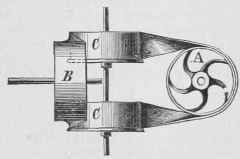
Corner-Turned Belt
Belts, Corner-turned, Device for.-The two shafts placed at right angles, as shown in the engraving, carry the belt from A or B, passing around two flanged pulleys or guides, C, turning loosely 011 a fixed upright shaft, and sustained in position by a collar under the hub of each. It is possible to run pulleys by this device which not only have varying diameters, but the shafts of which are on different levels; but the results are not so good, owing to unequal strain on the belt. It is better to confine this method to shafts on the same level, and to pulleys of equal diameter, and the useful limit of angle of shafts is that of 45°, or less. A greater or more obtuse angle is better run by means of guides on two uprights.
Continue to:


My Books

