


Trial Trip Of A Battle-Ship
Description
This section is from the book "Amateur Work Magazine Vol4". Also available from Amazon: Amateur Work.
Trial Trip Of A Battle-Ship
Albert Graham
To a few only is given the pleasure of witnessing a full power, speed and endurance trial of a large ship, such as our battleships and cruisers. I will try to describe to the readers of this magazine a trial trip of a
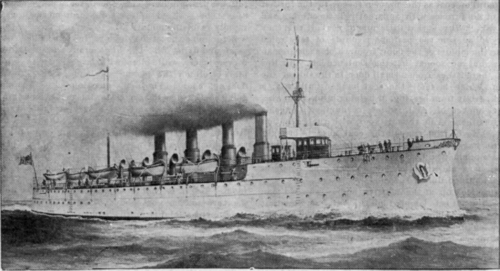
U. S. Scout Cruisers Chester, Birmingham And Salem sea-going war ship, and endeavor to show, in a very meagre way some of the life and action that is going on in the dark depths below decks.
On the night before the trial, and, in fact, for several days before, the massive machinery has been thoroughly inspected and made ready for the run. All depends upon the high efficiency of the power plant, and great care is exercised to see that there is no possible chance for an accident. Very early in the morning, long before the sun has even tinted the eastern horizon with the first signs of dawn, begins the vibration of auxiliary machinery throughout the ship, and a dull hum arises from the depths of the hold as the men are getting everything in readiness.
Dressed in an old suit of clothes and making a hasty toilet, we make our way along a narrow passageway to the brass-railed ladders leading to the engine rooms below. As we pass through the hatch in the protective deck, a gust of hot steam-and-oil laden atmosphere envelopes us, and far below in a misty light, forms are hurrying to and fro attending to duties too numerous to mention.
But down we go through a forest of pipes of all sizes, some hot, some cold, some as large as our body and others not larger than our middle finger, all apparently hopelessly jumbled into an inextricable mass with numberless hand wheels peeping out here and there. As we pass the middle landing our gaze falls for the first time upon the massive reciprocating parts of the main engines, all brightly polished and standing out boldly against the more puny columns, handling gear and pipes.
Upon reaching the lower landing, or engine room floor, a man rushes past with two buckets of oil, while all around us are busily engaged men, each performing some particular duty previously assigned. Passing forward through the power-closing, water-tight doors into the passage that leads to the fire-rooms, then through the air-lock doors, we are ushered into the first fire room.
Here all is life, bustle and activity. Great yawning incandescent mouths are devouring shovelful after shovelful of coal as the firemen toss it to the further end of the furnace with apparently little effort. And you ask, " Why, is that little pile of coal all that they carry? " as you see perhaps a couple of tons piled along the middle of the floor, from which each fireman takes, but no sooner has the sentence left your lips than there issues from a small door in the side of the room, which is really the coal bunker bulkhead, a black, grimy form bearing, or helping bring through a large bucket of coal, which is dumped alongside of the other. And thus it goes, with the exception that while on the run all the coal used is brought out in bags and each bag is supposed to contain an exact amount. One of the official observers counts these bags and thus determines the exact amount of coal burned during the run.
As we look up at the massive boilers we see a man whose duty it is to simply tend the water and see that it never falls below a certain point in the gauge glasses. Upon looking through a door in the center-line bulk-head we see another fire room just like the one we are in ; and, walking forward, we pass through two more.
We now go above and take a walk on deck where everything is quiet. Overhead floats a cloud of dense black smoke from the funnels forward. The sea is smooth and the stars are dimly twinkling a farewell as they retire before the rising orb, now just climbing over the edge of the sea, turning the intervening stretch into a lane of fire and liquid gold. We have not long to wait before we see in the distance a tug approaching, brim full of saucy importance and bearing the official observers, reporters, photographers and guests. As she nears the side we, for the first time, realize how massive our leviathan really is, as our rail towers way above the tall stack of the tug. One by one her passengers climb up the ladder on the side and gradually disappear below, while the tug backs away to await the visitors' return.
By this time everything has been made ready and we return to the engine rooms. On the bulkhead behind us are fastened gauges, clocks and various indicators, while below stands a large dial and gong, a mechanical telegraph connecting with the bridge from where the movements of the ship are directed. We are suddenly startled by the clang of the huge gong, and the pointer moves around to "Ahead, slow. " The engineer opens the throttle slightly and the huge arms begin to move up and down as the shaft revolves. There is hardly a sound, so perfectly does the engine run, and as the gong clangs again with the indicator pointing to "Ahead, Half," we realize that our ship has headed for the course.
Everthing seems to run like clockwork. All the auxiliary machinery is running steadily, and the large engines are turning over about sixty revolutions per minute. Our steam gauge has long since reached the 230 pound mark and our engineer signals that everything is in readiness.
Again the gong clangs out'" Full speed ahead " and a few turns of the throttle gives our engines 130 revolutions per minute. This speed, for a large engine, cannot be realized unless seen, for it means tons of rapidly revolving metal.
Before long the atmosphere begins to be filled with vapor and flying oil. The huge cranks are splashing it everywhere, while oilers with large syringes squirt pints of oil on the piston rods and guides. But oil does not count. The main question is to "keep her going cool." The floor soon "swims in oil " and lumps of white grease are spattered over everything within reach. As we pass into the shaft alley, the thrust collars and shoes are a mass of foam, and perhaps here and there a stream of water may be playing on a bearing to keep it cool. The damage a hot bearing may cause is, indeed, great, and no end of pains is spared to prevent it. You remark upon the coolness of the room. Yes, it is cool for an engine room. The temperature seldom goes above 85° or 90° in the winter, but somewhat higher in the summer and in southern climes.
Again we go into the fire rooms, but this time we are almost swept from our feet by the blast as the air-lock doors are opened. The fire-rooms are now closed and are under forced draft. Large fans are driving the air into the rooms under pressure, so that the fires may burn hotly and generate sufficient steam. You can see what force it has as the liner particles of coal are carried from the shovel into the furnace before reaching the open door.
You also notice how each furnace is fired in regular order. No adjoining furnaces are fired consecutively, but perhaps in this order: If there are eight furnaces in the fire room, 1 and 8, 3 and 6, 4 and 6, 2 and 7. This prevents too much unburnt coal being put into one furnace, which would chill it, and, besides, there is less cold air let into the furnace at one place. But upon our return to the eugine-room, behold our finely polished engines completely covered with a coating of white grease ; the floors are slimy and slippery with oil ; the men are soaked from head to foot with oil.
But as we are nearing the end of the course we go up on deck in time to see the last stake boat loom into sight, and we feverishly await the passing, for we are told that probably we shall make more than twentyfour knots per hour if we can pass her in twenty-three minutes. From the bows we are sending spray in every direction, and a churning mass of foam glides past us as we lean over the rail. Walking to the stern we see a turbulent churning wake stretching as far as eye can see.
Directly beneath us we see the silver-white blades cleaving the pale green water, and can almost trace the very thread that is being cut in the waves.
We are now passing the stake boat, and soon begin to make the turn for the return run. Our first run has been against the tide and our return will be, for the greater part, with it. But not for a moment has the throbbing pulse below ceased, and neither will it until the finish, for she must prove herself capable under the severest strain.
Continue to:


My Books

