


Photography. Passe Partouts From Negatives
Description
This section is from the book "Amateur Work Magazine Vol4". Also available from Amazon: Amateur Work.
Photography. Passe Partouts From Negatives
William A. Ingram
Passe partout binding strip is a very useful article for an amateur photographer to possess. It can be used for a number of purposes, among which may be mentioned masking negatives, binding lantern slides or transparencies, making a defective camera light tight, and sealing up a box of plates or dark slides. With its aid waste glass negatives, when the film has 'been removed, may be used as covers for photographs, thereby converting them into acceptable gifts, possessing that "personal touch " which adds much to the value of a gift.
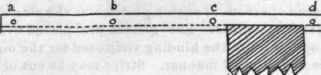
Fig. 1.
One experiences a certain charm in being able to make profitable use of "by products. " More pleasure is often derived from the conversion of an over-developed print into a transparency than from a print made specially for that purpose. The same may be said of a glass positive which has been used as a means for obtaining some other result, but is afterwards used as a. transparency. Waste negatives, like the poor, are always with us, and a means by which some of them can he used to advantage is well worth considering.
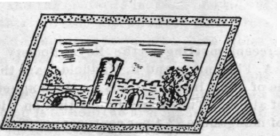
Fig. 2.
The amateur who uses but one size of plate is necessarily somewhat restricted as to the size of passe par-tout " frames " he can make from his waste negatives. Still if he is not an early beginner he will doubsless be able to find some negatives which can be permanently or temporarily masked, or prints which can be trimmed to sizes suitable for use with the waste negatives he may possess. While it may be rightly considered bad practice in ordinary cases to trim prints to suit a particular size of frame, still there is certainly some latitude admissible where a print is not exhibited as an artistic production, but rather as a photographic memento of a face or place one might wish to preserve.
Before being able to use to waste negatives the film must be removed. The perversity of some inanimate objects is proverbial, and waste negatives are a case in point. Should one inadvertently allow some developing solution to become a few degrees too warm there is a difficulty in keeping the film on the glass, but when one desires to remove the film after it has become thoroughly dry, it is quite another matter. This fact suggests a remedy applicable in some cases. When upon developing a plate it is seen to be useless, increase the temperature of the solution, and the film can be removed without difficulty. If the film has become dry, soak the negatives for several hours in cold water and then transfer to hot, when the gelatine will come away in one piece, or readily dissolve. The glass can be polished with any glass cleaning preparation.
The mounting of photographs for passe partout work calls for no special mention. Mounting card can be purchased at about ten cents a Bheet, each of which will cut upwards of 20 four by five mounts. A variety of colors can be obtained, but should anything special be required, drawing paper may be colored to the desired tint with water colors, and pasted over the ordinary mounting card.
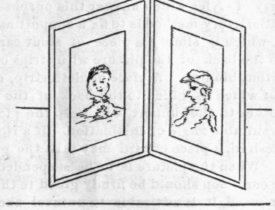
Fig. 3.
To center a photograph, take a strip of plain paper, the length of the glass to be used for a cover, and cut from it a portion equal to the length of the glass to be used for a cover, and cut from it a portion equal to the length of the trimmed print. Divide the remainder into two equal parts, and this will give the width of margin for the sides of the print. Obtain the size of margin for the top and bottom in the same manner. If the print be measured when dry, and mounted wet, an allowance should be made for the expansion of the paper. While this may not be necessary with small prints, it certainly should not be lost sight of with large ones, especially when the margin is narrow, in which case the difference in the width of margins is only to learned by experience.
To ensure the binding strip being placed correctly in position on the glass the following procedure is advised. Fasten the strip to a board with thumb tacks, gummed side upwards. With a pencil and ruler make a line on the strip, showing the position the glass is to occupy. Moisten a portion equal to the length of one of the sides of the glass on the strip, as shown at Fig. 1, in which a, b, c, d are the thumb tacks, and the shaded portion the glass. When this side is firmly fixed cut the strip and follow the same procedure with the three remaining sides. If one has any choice in the matter, glasses should be selected which have perfectly square sides. The mounted photograph must be exactly the size of the glass, placed in position, and the strips moistened one by one and turned over to the back of the mount, making the edges as square as possible, and neatly moulding the corners.
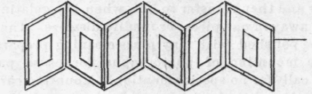
Fig. 4.
Some means of support or suspension must be pro vided. If the picture is to rest on a table or any similar place, it needs a support. Easels may be bought in a variety of styles which answer this purpose. However, a satisfactory method is to fix a support as shown at Fig. 2, which is simply a piece of stout cardboard hinged to the back of the picture with strips of cloth passe partout binding. A piece of cloth strip, or tape, one end of which is glued to the back of the picture and the other to the support, will keep the picture at the most suitable angle of inclination. If a rigid support be desired, a piece of card may take the place of the tape. When the picture is to be suspended a silk ribbon or cord loop should be firmly glued to the back. If cord be used, it is advisable to unravel about one inch of the ends, in which form it will make a much stronger connection with the back of the picture.
The above remarks apply to pictures treated individually. It is often advantageous to group two or more together, and the different methods of doing this seem almost limitless. Two may be hinged side by side, as shown at Fig. 3, or from the top with a piece of tape to regulate the angle of inclination. So arranged, they will, of course, support themselves. Pieces of cloth binding strip will make an effective hinge and take the place of the ordinary strips along the sides when they are used. More than two may be fastened together in a zig-zag manner, as shown at Fig. 4. This arrangement will sometimes be found convenient with panoramic views, thereby dispensing with the trouble of matching and joining the component parts. Such a combination may be made to fold, and thus occupy very little space when not displayed.
A passe partout photographic calendar makes a useful article. The calendar should have a piece of stout paper for the bottom sheet, which may be fastened to the outside of the glass with passe partout binding.
A pleasing variety of frame is made by using two different colors of binding strip. If one of these colors is white, or any light color that would easily soil, providing it is the color used for the inside border, it is advisable to place it inside the glass, for obvious reasons. This can easily be accomplished by fastening the white strip to the photograph mount, and then using the other colored strips is previously explained. Of course strips of more than two colors may be used if it be thought advisable.
A method of making significant pictures out of comparatively small photographs is to arrange several together. A piece of card is required the size of the whole of any such combination, and the photographs mounted thereon in such a position as the size of the glasses necessitate. The glasses are placed over the photographs and the binding strip used for the outside edges in the usual manner. Strips may be cut of suitable width for using between the different glasses. When such combinations are used the mounting card should be thick to prevent warping. In some cases it may be advisable to use two thicknesses of card. To a certain extent the tendency to warp may be avoided by pasting a piece of paper the size of the photograph on the opposite side of the mount.
An Italian inventor has produced a photographic machine with a film so sensitive that it will record 2000 separate impressions per second.
Continue to:


My Books

