


How To Build A Power Launch. VI. Installing the Engine
Description
This section is from the book "Amateur Work Magazine Vol4". Also available from Amazon: Amateur Work.
How To Build A Power Launch. VI. Installing the Engine
CARL H. CLARK
In choosing the engine, as good a machine should be purchased as the means at hand will allow. Although the four-cycle type is rather more reliable and economical of fuel, almost any of the two-cycle types will be found to give good satisfaction when well installed, and are much simpler and cheaper. An engine of medium weight should be chosen, as being less of a burden, and also, as having a higher rate of revolutions, the vibration will be less - the extremely light type should not, however, be used as the weight of metal is usually not sufficient to stand continued use. As to size, a three h. p. engine will probably do fairly well, but to obtain the best results a 3 1/2 or even 4 h. p. may be made.
It is hardly necessary, in a boat of this size, to use any kind of reversing apparatus, although a reversible propeller is sometimes useful and is quite desirable if a good type be obtained. If the question of cost enters into the matter, the reversing apparatus may easily be dispensed with and a plain shaft and wheel fitted. The fact that most two-cycle engines will run in either direction and may, with sufficient skill, even be reversed will help to decide the question.
The construction of the engine bed has already been described and the engine must now be fitted into place.
A fine wire is passed through the shaft hole, stretched tight, and fastened so that it is in the exact center; this locates the center of the shaft. The engine is now measured to find the exact relation of the bed flanges to the shaft center; they will usually be either in the line of the center or slightly below it. The bed is now trimmed down until it bears the same relation to the wire that the flanges do to the shaft center. The engine is now lifted in place and the propeller shaft passed through and secured in place to the engine coupling. When the engine is correctly set the shaft will be exactly in the center of the hole; it is then fastened into place with lag screws.
The stern bearing should be shipped on to the end of the shaft and fitted to the back side of the stern-post. The latter is trimmed until the bearing bears evenly against it without cramping the shaft. It should be borne in mind that the joint between the bearing and the sternpost must be water tight to prevent leakage into the boat through the shaft hole. The bearing is fastened into place with lag screws, after smearing with white lead. In some makes of engines the stem-bearing is fitted on the inner end of the shaft log, and a plain bearing on the other end; this is the preferable method, as then the gland may be tightened more readily.
The shaft will usually be sent several inches length to spare. One end will be already fitted to the propeller. Careful measurements should be taken and the shaft cut to such a length that there will be sufficient length between tbe propeller and the bearing, that the cap may be removed and the gland packed without trouble. The propeller is securely fastened to the shaft by the means provided, the shaft is put into place and the set screws in the coupling set up tight. After this is done the engine should turn freely if everything is properly in line. When the engine is properly set the remaining pieces of floor may be fitted and laid, a suitable opening being left in front of the engine to allow starting with the handle.
The piping may be arranged all on one side of the engine, leaving the other side open for the passage, or if it is desired to have both sides of the engine clear, all pipes may lead directly down from the engine to the door, and a light guard or slip be fitted over them.
The exhaust piping should be fitted first, as it is the largest and hardest to handle. The muffler should be placed athwartships under the after seat. The openings for pipes on the different makes of engines vary to such a degree that exact directions cannot be given. The exhaust should be piped from the engine to the space under the seat, ending in an ell; from this ell a straight pipe runs aft under the seat and is connected to the muffler with an ell. The exhaust from the muffler passes out through an ell, up and aft and out through the sternboard. A locknut is fitted on the exhaust pipes inside and outside of the stern board to secure tightness. The exhaust pipe should be kept clear of all wood work as far as possible, and whenever this cannot be done the woodwork should be covered with asbestos.
The inlet for the cooling water should be well below the water line. A perfectly tight joint should be secured with lockers and washers inside and outside. It is the common practice to fit a short piece of pipe to the plank and make the remainder of the connection to the engine with a rubber hose; in which case the jar of the engine will not tend to loosen the pipe in the plank and cause a leak. The outlet from the engine should lead out through the side of the boat above the water. The inlet should be covered with a strainer to prevent the sucking in of sand or other material. The joints in the water piping should be made up with red lead to assure tightness.
The pipe from the gasoline tank is best of lead securely solderd to unions at each end. A stop-cock should be fitted on the tank and another at the vaporizer; this will allow the pipe to be disconnected if necessary, without emptying the tank. Great care is necessary to have all the piping connected with the the gasoline absolutely tight. The filling pipe for the tank should extend up through the deck in one piece, leaving no open space through which the gasoline would have to pass, allowing it to generate vapor. The lead gasline pipe should be led in such a manner that it is in no danger of damage, as it is quite soft and easily jammed. Joints in the gasoline pipe should be made up with shellac or soap, as red lead will be eaten out by the gasoline and leaks caused.
If pipe dies are not at hand, the pipe may be taken to a pipe fitter together with careful measurements, and pipe cut by him. The pipe for the exhaust may be of galvanized iron and that for the cooling water of brass.
For ignition two sets of batteries should be used of six each, they should be arranged in a box of requisite size, as shown in Fig. 1. The rows are connected up-separately, the zinc of one cell to the carbon of the next, and so on. On one end of the box is fitted the three-pole switch, B, which allows either set to be used as desired, the wires from the carbons of the end cells being connected to the poles of the switch. The zincs of the cells at the other end are connected to one
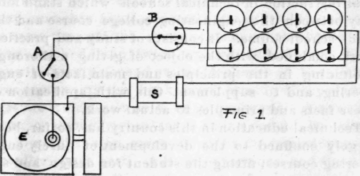
Wiring Diagram for Engine.
wire, which leads to one terminal of the spark coil, S. From the other terminal of the coil a wire is led to some part of the engine or piping and a good electri-trical connection made. From the third point of the battery switch a wire is led to one point of the two-point switch, A, and from the other point.of this-switch to the insulated electrode of the engine. The switch, A, is placed near the engine and allows the current to be cut off when the engine is not in use. The battery box should be placed in some dry location,. together with the coil, which may be fastened to the box if desired. The wiring should be very carefully done, as a large part of gasoline engine troubles are caused by defective electrical outfit. The connections-for a jump spark ignition will be much the same, differing principally in the connections at the engine.
When purchasing the engine, the buyer should obtain all the information possible in regard to its installation and operation, as in this way mnch time and labor may sometimes be saved.
When all the work has been done the final coat of paint should be given and all seams filled with rather soft putty, which will be easily squeezed out when the planks swell. The boat should then be launched.
If the builder is not familiar with gasoline engines it will be well to obtain the services of an experienced person for the trial trip, and the amateur is advised to obtain one of the several good books on this subject and make a study of it so as to familiarize himself with the theory and principles of operation.
During the first few weeks of running, plenty of lubricating oil should be used until the various bearings become smoothed down to a good wearing surface, and care should be taken that no grit or other material finds its way into them to cut them out.
With proper care both engine and boat should last for several years with only minor repairs.
The hull should be smoothed up after two or three months and another coat of paint applied. All varnished work should also be kept well covered during the first year to avoid cracks and checks while the wood is setting into place. It is hoped that with these instructions the amateur will be able to construct an able and satisfactory boat, and one which will give pleasure to himself and his friends for many years.
Continue to:


My Books

