


Electric Batteries. Their Construction And Uses. II. Polarization - Single and Doable Fluid Cells
Description
This section is from the book "Amateur Work Magazine Vol4". Also available from Amazon: Amateur Work.
Electric Batteries. Their Construction And Uses. II. Polarization - Single and Doable Fluid Cells
FREDERICK A. DRAPER
As noted in the previous chapter, during the action of a cell, the hydrogen bubbles which are liberated collect on the surface of the negative plate or cathode, and unless removed by chemical or mechanical means, obstruct the chemical combination producing the difference in potential between the electrodes of the cell, and the current flowing through the external circuit is decreased. This is known as "Polarization," and its removal is termed "Depolarization."
Several methods have been used to remove the hydrogen bubbles, such as agitation of the fluid, which causes the bubbles to rise to the surface and pass off into the air; accomplishing the same result by heating fluid or by forcing air through it. These methods are all of external operation, the power usually being of clockwork except in the case of heating. They have no advantages over the method in general use, the chemical one, in which the negative element is surrounded by a solid or liquid substance possessing great affinity for the free hydrogen. The free hydrogen readily unites with the depolarizer, providing the current developed by the battery is not great enough to evolve hydrogen in excess of the capacity of the depolarizer to unite with it. It is evident, therefore, that the design of a cell, and the area and quantity of its elements must be proportioned to the current to be drawn from it.
The depolarizing chemical is one rich in oxygen, which unites with the free hydrogen to form water, thus gradually diluting the electrolyte until eventually the cell is so weak as to require a new supply of electrolyte for continued use. Where a depolarizing chemical is used, it is also necessary to select elements which will have little or no affinity for the depolarizing chemical, else when no current is passing through the external circuit, the action within the cell, known as " local action," will continue, and the elements used up without having performed useful work in the external circuit. It is necessary then, in order to have a practical cell, that the elements composing it should be without action, except when the electrolyte is decomposed by the passage of the current.
It is also desirable that the difference in potential between the electrodes be as great as possible, that the output of the cell be large. Here again the depolarizer may be of value, as, if possessing affinity for one element only, the resulting combination therewith develops a potential difference which is additional to that of the decomposition of the electrolyte, and so increase the E. M. F. in the external circuit. On the other hand, if more than one element in a cell has an affinity for the depolarizer, combination takes place, independent of the decomposition of the electrolyte, and the E. M. F. in the external circuit is reduced. This explains why two cells in which the same metals are used, but with different electrolyte and depolarizer, do not give off the same E. M. F. in the external circuit, or continue in efficiency for the same length of time. The reason for the wide variety of combinations to form the numerous cells on the market is also evident, each type having uses for which it is best adapted, and to explain which is the purpose of these articles.
The metal most nearly answering to the requirements already noted is zinc, which, in proportion to the energy which may be developed by chemical combination, is also the cheapest metal which can be used, and hence we find it in almost universal use in those forms of cells in common use. Unless refined for electrical use, the impurities usually to be found in commercial zinc cause local action which diminishes the efficiency of the cell and which is avoided by amalgamating the surface with mercury.
A convenient way of amalgamating zinc is to first thoroughly clean the surface of the metal of grease with common washing soda and warm water and then rinsing it in running water, with a pledget of cotton wool which has been dipped in dilute sulphuric acid (water 10 parts, acid 1 part, by bulk), rub the surface of the metal, and while rubbing, pour on the mercury, drop by drop, spreading it over as great a surface as possible with the pledget. Another way is to mix the mercury with the acid solution and apply with the pledget. In either case care must be taken to avoid the use of too much mercury, as it causes the zinc to become brittle and easily broken. Amalgamating the zinc is of value only when an acid electrolyte is used; with a saline solution it has little or no protective effect.
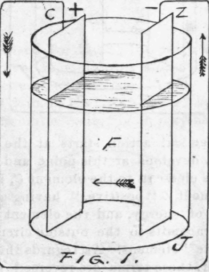
In some forms of cells the formation of free hydrogen is not great enough to seriously affect the normal action of the cell, even if no depolarization is used, or if one be used, it is in solution with the exciting fluid. This leads us to divide the various forms of batteries into general classes, viz., "single fluid " and "double fluid" cells. The single fluid cell is illustrated in Fig. 1 in which J is the containing jar, .F the exciting fluid, which may or may not have in admixture with it a liquid having affinity for the liberated hydrogen; in this fluid are the plates Z and C. The plate marked Z is a metal readily acted upon chemically by the exciting fluid and C a metal which is a good conductor of electricity, but upon which the exciting fluid has little or no action. The function of plate C, is to collect and convey to the external circuit the electrical force resulting from the chemical action between the exciting fluid and the plate Z.
As the chemical action starts at the plate Z and the E. M. F. develops at this point and flows in the cell from this element to the element C, it is usual to term the element Z "positive, " having as it does the higher level of energy, and the element C, which receives and transmits to the outside circuit, is termed the "negative " element. As regards the outside circuit, however, these terms are reversed when applied to the points of junction with the outside circuit, and known as the " poles " of a battery. The positive pole is that from which the current flows, and the negative pole that by which it returns to the cell. Keeping in mind the fact that the point of origin is positive, whether applied to element or pole, will serve to keep clear this apparently contradictory application of terms.
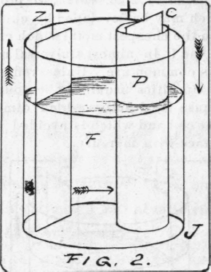
In the double fluid cell, as illustrated in Fig. 2, we note the addition of the porous pot P, in which is placed the carbon plate, and also some fluid or sub-stance having great affinity for the free hydrogen which would ordinarily collect upon the surface of the negative element C. Either positive or negative element may be placed in the porous pot, providing always that the depolarizer shall accompany the negative element.
It is also important that the pot be very porous, for while it serves to separate the exciting fluid and depolarizer, it must offer the least possible obstruction to the action of the cell causing the flow of the current.
Continue to:


My Books

