


A New Glow Lamp
Description
This section is from the book "Amateur Work Magazine Vol4". Also available from Amazon: Amateur Work.
A New Glow Lamp
It is credited to electric lighting, even by its worst enemies, that it has made the gas people wake up. The gas lamp has been much improved, and as the process has gone on there has been evidence of a reaction on the newer light. It will be remembered that in the beginning of electric lighting all the efforts of electric inventors were concentrated on the problem of producing a decent lamp. Then came a time when the carbon glow lamp was accepted as practically perfection, and the efforts of engineers were devoted to the cheapening of the production and distribution of electrical energy. Once again the pendulum has swung back, and the market is full of new lamps, and the tale of new lamps. The last example comes from Germany and threatens to be a formidable competitor of those established or seeking establishment. The Siemens & Halske Company has been for a long time engaged in an endeavor to improve the electric light at a place where there is the greatest room for improvement, viz., the hopelessly inefficient glow lamp ; but the matter has been kept very quiet ; indeed, the first publication was made at a meeting of the Berlin Elektrotechnischer Verein, on the 17th ult., when two papers were read by Mr. O. Feuerlein and Dr. von Bolton. The papers, and the communication of Mr. W. von Siemens are reproduced in the "Elektroteconische Zeitscrift" of January 26, with illustrations of the lamp and filament. There is, therefore, no longer any secrecy about the matter, and indeed one may expect to find the lamps upon the market almost immediately.
The new lamp has a metallic filament and, in fact, appears to constitute a solution of a problem to which Mr. Edison originally set himself without result. Undeterred by his failures the Siemens & Halske Company, some very considerable time ago, set Dr. von Bolton to work on the task of finding a substance capable of being drawn into a filament, and having a melting point so high that it would give a white light before failing. What Dr. von Bolton has done is to ransack the unused elements, and it seems that he has found what is wanted in tantalum. All that is known by most people of the properties of the so-called rare elements is the descriptions of them at the end of the chemistry books. These are mostly wrong for the simple reason that the things have been prepared once or twice by men who were not metallurgists, under circumstances of considerable difficulty, and without hope of any commercial gain which would justify the expenditure of time and money in purification. Of the two standard ways of getting anything which resists ordinary methods of reduction, the electric furnace invariably involves pollution with carbon. Electrolysis of the fused salt belongs rather to an element of a low melting point, and everyone knows the difficulty of getting a pure deposit. In fact, to draw any conclusions from the descriptions of the unused metals that appear in the books is very much the same as if one were to argue on the electrical possibilities of Fe from a small specimen of cast iron. Dr. von Bolton, in the course of his researches, tried vanadium, and found its melting point (as indeed he should have had fair warning, was much too low. The obvious course was then followed of trying the remaining elements of the same class - first niobium and then tantalum. The tantalum he has obtained is an entirely different substance to the tantalum of the books.
Pure metallic tantalum resists acids like platinum. It will burn in air, so that the lamp must be run in a vacuum; it absorbs hydrogen, nitrogen and carbon. Consequently, the tantalums that we have been put off with hitherto, though metallic in appearance, were really compounds or alloys. The tensile strengh of pure tantalum is 25 per cent.better than steel. It can be drawn into wire and it has the property which is so valuable in soft iron, viz., that it becomes malleable long before it actually melts.
Its electrical properties are even more convenient ; the resistence of a meter wire of one square millimeter cross section is .16 ohms, but when run at its working temperature the resistance rises to .83 ohms, (say five times as much). Metallic tantalum has, in fact, as becomes a metal, a strong positive temperature coefficient. The ordinary carbon filament is, as is well known, deficient in this respect, though not (when at the temperature of incandescence) to such an extent as to make special treatment necessary, but the negative coefficients of the Nernst and of the arc constitute an effective nuisance.
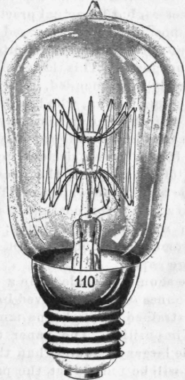
The chemical difficulties of the manufacture of tantalum, which are not very serious, being removed, the mechanical problem remained of constructing a glow lamp that should have a filament two or three feet long, so as to run at a reasonable voltage, and this part of the work was out by Mr. Feuerlein. How the difficulty has been overcome will be seen from the illustration of the filament given herewith. The wire is looped round and round on a kind of frame. All metallic filaments are necessarily low resistance filaments, but it will be seen that, after all, there are compensations in working in metal instead of in carbon, or in a brittle paste of oxide. The type of lamp is already standardized for 110 volts 24 candles, and this lamp has a consumption of 1.6 watts per c. p. The filament is 25 inches long and has a diameter of .05 millimeter. As the weight of it is 22 milligrams, a pound of tantalum will make more than 20,000 lamps. The life of the lamp is about 500 hours, till at 1,000 hours it becomes a 2 1/2 watt lamp. It is, therefore, quite possible that it may end as the 1,000 hour lamp that we are used to. It will be seen that the consumption renders the lamp an immediate competitor of the Nernst and the small enclosed arc. Its great point is that, like the osmium lamp of Dr. Auer von Welsbach, it contains no mechanism. The physical, as apart from the economic end of the lamp's life, appears to come when the wire becomes mis-shapen and brittle. Repeated expansion and contraction results in a shortening the length of the filament and a roughening. The new filament is quite tough, but old lamps should not be taken out or shaken (as with the gas mantle). Curiously enough, a broken lamp can frequently be mended by a simple process of tapping it until the loose ends touch together, when they weld themselves together. It then, of course, goes, on as an over-run lamp. A similar habit was promised for the Nernst burner, but nothing came of it, and it seems unlikely that this auto-repairing faculty will come into practical use. The appearance of the filiament has already been illustrated; it merely remains to add that it is inclosed in a vacuum bulb in every respect similar to that of the glow lamp of commerce. The limits of the voltage and size mentioned do not seem in any degree fixed. It is possible that they may be capable of considerable extension, but at present only 100 to 120 volt 24 c. p. lamp can be procured.
After the reading of the papers at Berlin some additional information was given by Mr. Wilhelm von Siemens; but except for the opening remarks of the chairman, Dr. Micke, there seems to have been no discussion. Beyond appreciation of the labors of Dr. von Bolton and Mr. Feuerlein, the important part of Mr. Siemen's speech was a declaration that the lamp was quite ready. The development has been done without any preliminary writing in the newspapers, and not a word has been said about it until the company has not only got a lamp that will go, but is ready to go on turning them out for the market at the rate of 1,000 per day. Specimens of the present pattern have been running for a year.
There remains one point upon which the tantalum lamp is somewhat tantalizing; there is no information in the paper upon price. As regards the osmium lamp, with which one naturally compares it, when its producers have been asked whence they are going to get their osmium, they have replied in terms which, translated out of the language of politeness amount to
" That's our business; we have got it. " At the same time, one naturally wants to know in what quantity. There is this about tantalum, that, although supposed to be a rare element, it exists in a quite sufficient quantity, even if no fresh . discoveries are made, to provide the material of glow lamp filaments. That difficulty is no more likely to arise than in the case of finding sufficiency of the elements of the cerium group to make Welsbach mantles. And when manufactured in quantity there seems nothing in the process of production which should make it a matter of physical necessity that the new lamp should be excessively dear. It appears that the metal is reduced from the double fluoride of potassium and tantalum substantially after the manner to be found in the books. The impossible looking powder thus obtained when heated electrically under the air pump, parts with the gases it has ob-sorbed during the process of manufacture, and fuses into a workable metal- Electrical Times, London.
Continue to:


My Books

