


Tools And Their Uses,
Description
This section is from the book "Amateur Work Magazine Vol3". Also available from Amazon: Amateur Work.
Tools And Their Uses,
Cold Chisels are used for cutting metal. The more commonly used shapes are here illustrated. The Flat is used for wide cuts of no great depth. The Cape is used for narrow cuts, and in the hands of a skilled workman such accurate work as keyways in shafting can be done with this tool, a file being used for finishing. The Bound Nose is used in corners, and where its shape makes it more desirable than the two previously mentioned. The chisel is held in the left hand, at the angle best suited to the cut, and given forcible blows with a machinist's hammer, the latter being made of hardened steel to prevent the face from becoming indented. Considerable practice is necessary before the worker can do efficient work with a cold chisel, and yet avoid mis-strokes with resulting damage to the knuckle of the forefinger.
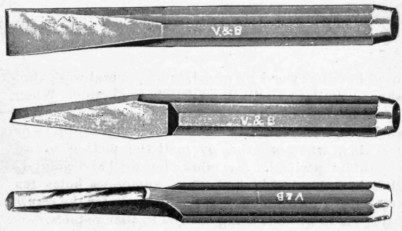
Flat, Cape and Round Nose Cold Chisels.
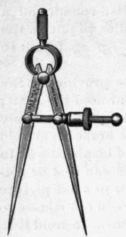
Compasses, or as they are now more commonly termed dividers, are used to lay off circles, angles and arcs; to take measurements, and lay off the same on drawings or work. Also used as a " Scriber " to take of the line of a surface on work, one point following the line of the surface and the other marking the same on the work. The knurled handle projecting above the bow is of great assistance when striking circles, arcs, etc., giving ease of movement and an unobstructed view of the work. For large circles, arcs, etc., Trammel
Points on a long beam are used. Crude points for such work can be made by putting pointed wire nails through a strip of thin wood, these serving where no great accuracy is required.
Cotters are used for holding wheels, pulleys, and other parts of mechanism upon a shaft or similar bearing where a nut or other part has a tendency to work apart. Pins in moving joints are retained in position by cotters at the ends, these uses requiring a split cotter. In piston rods for pumps and engines, they are solid and serve to keep the parts of a bearing or joint in position.
Compass Saw, See Saws.
Counter-sinks, are used in machines or bit brace for giving a V shape to the outer end of a hole in metal or wood to receive the head of a screw. The Snail countersink is used in wood; the Rose may be used in either wood or metal, but for metal work that shaped similar to a diamond drill is preferable. When used in a machine the shanks are straight, and as each shape is made with shanks for either bit-brace or machine, when ordering by mail the method of use should be specified. A combination drill and counter-sink is a very handy tool when numerous holes for screws are to be made, the hole ready for the screw being made without being obliged to change tools.

Continue to:


My Books

