


A Chamber Set. The Bureau
Description
This section is from the book "Amateur Work Magazine Vol3". Also available from Amazon: Amateur Work.
A Chamber Set. The Bureau
John F. Adams.
The general dimensions for the bureau are: Size of mirror, 42x30"; top board over drawers, 50x22". Other sizes can be worked out by anyone desiring, the general proportions being retained. The stock required is as follows:
2 pieces | 36" long | 2 1/2 x l 3/4" | ||||
2 " | 64 " | 2 1/2 x l 3/4" | ||||
2 " | 30 " | 17 1/2" | wide | 7/8" | thick | |
4 " | 45 " | 3 " | " | 7/8" | " | |
2 " | 45 " | 2 " | " | 7/8" | " | |
2 " | 33 " | 2 " | " | 7/8" | " | |
1 " | 50 " | 22 " | " | 7/8" | " | |
2 " | 43 " | 9 1/2" | " | 7/8" | " | |
2 " | 21 1/2" | 6 " | " | 7/8" | " | |
30 feet of 7/8" white wood strips 2i" wide, and white wood for sides and bottoms of drawers, etc.
The first operation is to cut mortices in the front posts to receive the ends of the cross piece under the lower drawer. This cross-piece is 45" long, 3" wide and 7/8" thick, allowing 1" on each end for tenons, which are 3x1/2". The posts are 36" long, 2 1/2" wide and 1 3/4" thick, the mortices being cut with lower edge 6" from the end. The rear posts are 64" long, 2 1/2" wide and 1 3/4" thick. Mortices are cut in these posts for the cross piece under the mirror frame, which is 45" long, 3" wide and 7/8" thick, the mortices being 3xlx1/2", and the lower edges 36 7/8 " from the end of the posts.
The end pieces 30" long, 17 1/2",wide and 7/8" thick, are then glued to the posts after marking out and boring six 3/8" holes into each edge to a depth of about 4" and corresponding holes in the posts into which dowel pins are glued. The edges of the end boards are well coated with glue and the ends are then set up in clamps until thoroughly dry. The outer surface of the end board is set in 3/16 from the posts.
While the ends are drying the drawer runs are made from strips of whitewood 2 1/2" wide with the exception of the front sides of the runs under the top and middle drawers, which are of the same wood as the bureau, and the one under the lower drawer which has the cross piece for the outer edge and a piece of white wood just back of and glued to it. The frame under the upper drawers also has a cross piece in the centre which is morticed in. The corners of these frames are cut out to fit the posts. When completed they are screwed to the ends after the cross piece under the lower drawer and mirror have been put in place. Cabinet-makers' clamps must be used while the glue is setting. The frame under the top drawer is placed 7" from the top ends of front posts, that under the middle drawer 9 1/2" below the first, and the lower frame is flush on the upper side with the top of the cross piece. An additional frame is then made of 3/4" strips or of solid stock 48" long and 21" wide and attached firmly with wood screws to the top of the front posts and end boards. The top, 50" long, 22" wide and 7/8" thick, is then put on, glue and screws from the under side being used freely to secure ample strength. A suitable moulding is run around the under edge, covering the edges of the under frame. The frame for the mirror is made of 7/8" stock 2" wide, the longer pieces being 44f" long and the side pieces 33" long. The corner joints are mitred on front side, and mortised and tenoned also. The inner back edge is rabbeted 1/2 x 3/8" to receive the mirror, picture backing being used to protect back from breakage. Swivel hangers for holding the mirror are to be purchased of hardware dealers and, are placed slightly above the centre line and so that the lower edge of the mirror will clear the cross piece by about 1/4".
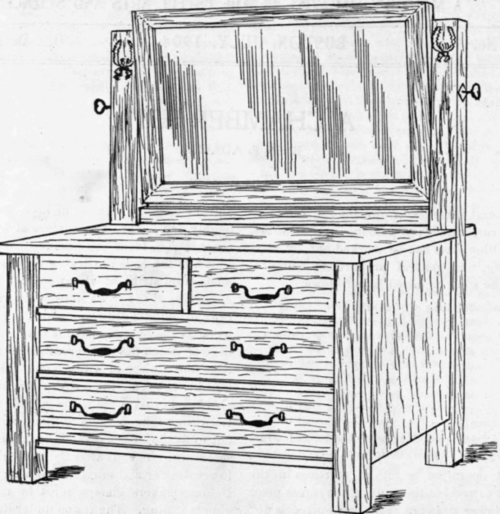
The drawers are made with halved joints, though dovetailed ones would be better and stronger, but take longer to make. A division piece between the two upper drawers is put in before putting on the top. By examining the drawers in any bureau the method for making them can be easily learned, so is not here given. The drawer pulls should be of cast brass ; castors are also fitted to the bottom of the posts.
The back of the bureau is sheathed with 1/2" matched sheathing, the inner edges of the drawer runs being placed to allow for this.
Continue to:


My Books

