


Oval
Description
This section is from the book "A Practical Workshop Companion For Tin, Sheet Iron, And Copper Plate Workers", by Leroy J. Blinn. Also available from Amazon: A Practical Workshop Companion For Tin, Sheet Iron, And Copper Plate Workers.
Oval
Fig. 79. To describe an Ellipse or Oval, having the Two Diameters given.
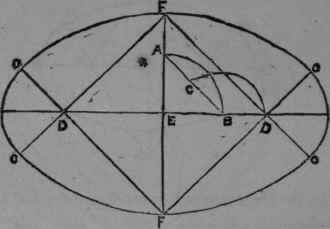
On the intersection of the two diameters as a centre, with a radius equal to one-half the difference of the two diameters, describe the arc AB, and from B as a centre, with half the chord ACB, describe the arc CD; from E as a centre with the distance ED cut the diameters at FF and DD; draw the lines FO, FO, FO, FO; then from F and F as centres, describe the arcs 00, and 00; also, from D and D as centres, describe the smaller arcs, 00 and 00, which will complete the ellipse as required.
Oval.
Fig. 80. To draw an Ellipse with the Rule and Compasses, the transverse and conjugate Diameters being given; that is, the Length and Width.
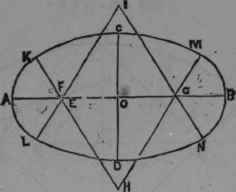
Let AB be the transvese or longest diameter; CD the conjugate or shortest diameter; and 0 the point of their intersection, that is the centre of the ellipse. Take the distance OC or OD; and, taking A as one point, mark that distance AE upon the line AO; divide OE into three equal parts, and take from AF, a distance EF, equal to one of those parts; make OG equal to OF with the radius FG, and F and G as centres; strike arcs which shall intersect each other in the points I and H; then draw the lines HFK, HGM, and IFL, IGN; with F as a centre, and the radius AF, describe the arc LAK; and, from G as a centre, with the same radius, describe the arc MBN; with the radius HO, and H as a centre, describe the arc KCM; and from the point I, with the radius ID, describe the arc LMD. The figure ACBD is an ellipse, formed of four arcs of circles.
Continue to:


My Books

