


420. Blow Pipe Welding
Description
This section is from the book "An Elementary Outline Of Mechanical Processes", by G. W. Danforth. Also available from Amazon: An elementary outline of mechanical processes.
420. Blow Pipe Welding
The flame of a combustible gas may be so regulated in its shape and intensity by a properly constructed burner that it can be effectively used for local heating such as is needed in welding. In the compound blow pipe, a type of which is shown in Fig. 264, oxygen is admitted to one tube of the burner and a combustible gas is admitted to the other tube. These two gases pass along the channels 1 and 2, mix in the small receptacle 3, and finally pass from the nozzle at 4 where they enter the flame.
Oxygen is supplied from a steel cylinder in which it is stored under a pressure of 100 atmospheres or more, passing through a reducing valve which lowers the pressure to 30 pounds or less per square inch in the burner.
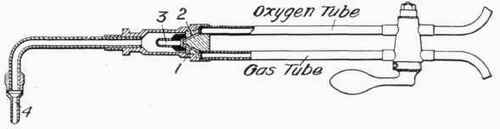
Fig. 264. - Compound Blow Pipe.
Hydrogen and acetylene gas are much used as the combustible gas. They may also be stored in steel cylinders as a convenient means of transporting them from the factories which make them, but acetylene gas is so easily produced that it is frequently made where it is used. Great care must be taken to avoid an explosion in using or handling any kind of inflammable gas. Acetylene is stored in steel cylinders with acetone, a liquid which absorbs a large volume of the gas under heavy pressure, thus avoiding the danger of this particular gas when compressed. In its simple process of production - that of admitting water to calcium carbide in a closed vessel - its explosive tendency is not always realized. A spark of flame coming in contact with the gas will cause an explosion in force and volume depending upon the amount of gas and oxygen or air in mutual contact.
As the mixture of oxygen and gas flows from the blow pipe, it burns in a flame which is regulated to suit the work to be done. The supply of each gas is so controlled by a small valve that the relative amounts and pressures of the two may be regulated as needed. The gas mixture should issue from the blow-pipe nozzle rapidly enough to keep the flame from following the mixture back into the pipe, and on the other hand the flame should not receive too strong a blast by too rapid a flow of gas. The quantity of oxygen must be kept down enough to avoid an oxidizing flame in welding.
Slightly different forms of blow pipes, determined by experiment, are necessary for burning gases under different pressures and different intensities of flame, according to the requirements outlined in the preceding statements.

Continue to:


My Books

