


Watt's Patent
Description
This section is from the book "The Engineer's And Mechanic's Encyclopaedia", by Luke Hebert. Also available from Amazon: Engineer's And Mechanic's Encyclopaedia.
Watt's Patent
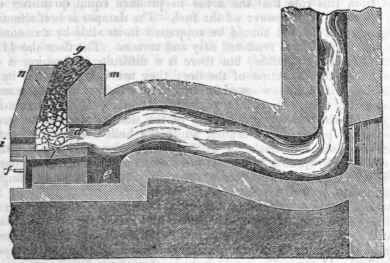
The earliest application in this country of apparatus for consuming the dense smoke of furnaces, that we are acquainted with, is the invention of Mr. Watt, in 1785, before alluded to. It is thus described by him in his specification: " My newly improved methods of constructing furnaces or fire-places, consist in causing the smoke or flame of the fresh fuel, in its way to the flues or chimney, to pass, together with a current of fresh air, through, over, or among fuel which has already ceased to smoke, or which is converted into coke, charcoal, or cinders, and which is intensely hot; by which means the smoke and grosser parts of the flame, by coming into close contact with, or by being brought near unto, the said intensely hot fuel, and by being mixed with the current of fresh or unburned air, are consumed or converted into heat, or into pure flame, free from smoke. I put this in practice, first, by stopping up every avenue or passage to the chimney or flues, except such as are left in the interstices of the fuel, by placing the fresh fuel above or nearer to the external air than that which is already converted into coke or charcoal; and by constructing the fire-places in such manner that the flame and the air which animates the fire must pass downwards, or laterally, or horizontally, through the burning fuel, and pass from the lower part or internal end or side of the fire-place to the flues or chimney." Mr. Watt then gives an example and a description of the application of this principle in his specification, which we do not here insert, as there have been some improved arrangements introduced which we shall have occasion to notice elsewhere. The specification next proceeds to state as follows: "In some cases, after the flame has passed through the burning fuel, I cause it to pass through a very hot funnel, flue or oven, before it comes to the bottom of the boiler, or to the part of the furnace where it is proposed to melt metal, or perform any other office, by which means the smoke is more effectually consumed. In other cases, I cause the flame to pass immediately from the fire-place into the space under a boiler, or into the bed of a melting or other furnace." We annex the inventor's example of this arrangement of the furnace, as it is simpler than the former, and equally effective, a a represents a reverberatory furnace, for melting iron, of which b is the flue; e is the ash-pit, and f a door thereto; g is a hopper-like receptacle for the fresh fuel, which gradually sinks down as it is consumed beneath; - about the middle of this mass of fuel it is intensely hot, as it consists of coals and coke that have ceased to smoke.
At i is an opening or openings to admit fresh air, and regulate the fire. At the opposite end of the furnace is another door, to be used either for charging the furnace or stopping its operation, which is effected by the counter current produced by the opening of the door. The fire is first lighted upon the brick arch l, and when well ignited, more fuel is gradually added, until it is filled up to g, care being taken to leave proper interstices for the air to pass, either among the fuel, or between the fuel and the front wall; and as much air is admitted at the opening i as can be done, without causing the smoke to ascend perpendicularly from g, which it would do if too much be so admitted. "Occasionally the opening at g is closed with a cover, to cause the air to enter wholly or partially at i." By this addition, it will be noticed, Mr. Watt first applied the closed hopper, now so much used in the feeding of furnaces.
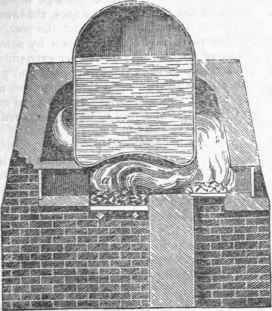
The following figure exhibits another admirable contrivance of Mr. Watt's, which many succeeding inventors have claimed as their own, as well as that piar already described. Mr. Watt observes, - "In some cases l place the fresh fuel on a grate, as usual, as at a, and beyond that grate, at or near the place where the flame passes into the flues or chimneys, l place another smaller grate b, on which l maintain a fire of charcoal, coke, or coals, which have been previously burned, until they have ceased to smoke, which by giving intense heat, and admitting some fresh air, consumes the smoke of the last fire."
Continue to:


My Books

