


Acetylene Gas Generator
Description
This section is from the book "Cassell's Cyclopaedia Of Mechanics", by Paul N. Hasluck. Also available from Amazon: Cassell's Cyclopaedia Of Mechanics.
Acetylene Gas Generator
The various patented apparatus for making acetylene gas from carbide of calcinm have generally had the idea of working automatically, so that as the gas is consumed a fresh supply is made, and the plant thus made continuous. The two methods generally adopted are either that the carbide shall be added to the water or, what is perhaps better, the water added to the carbide. Carbide, however, has such a great affinity for water that it will take it from any source, and consequently the manufacture of the gas often goes on long after the gasholders are full. The chemical action is expressed by the following formula. CaCa + H2O = C2H2 + CaO, showing that when carbide of calcinm (CaC2) and water (H2O) are mixed the result is acetylene (C2H2) and lime (CaO). One pound of calcinm carbide will make 5 cub. ft. of gas. The safest method of making an acetylene gas generator is to follow the lines of a coal-gas making plant, and to have a gasholder large enough for the daily consumption, and to introduce so much fresh carbide as will serve just to fill the gasholder each day. The apparatus is very simple to make.
It should consist of a rather deep sheet-iron tank, so that both the gasholder and the retort may be inserted in it, while the former may be allowed to travel up and down inside the upper portion of the tank, which will thus form guides for keeping the gasholder vertical. As carbide gives off a considerable amount of heat when acetylene is being formed, and as this is likely to prove dangerous it is best to have the retort, and the pipe from it to the gasholder, under water. Such an arrangement is shown in the sketch. The retort A is best made of castiron, with a flange for fastening to the sheet-iron tank, and a lid to be fixed on by a cross bar fitting into two ears or lugs on the sides of the retort. The pipe C for supplying water to the retort is brought out from the tank, and a cock F fitted so that it can be shut off. The supply-pipe D to the gasholder B is arranged in like manner, so that when recharging the retort the cock can be closed and the gas in the gasholder preserved. E shows the gas outlet pipe. The water in the gasholder tank will absorb a large quantity of acetylene gas until saturated.
Acetylene has approximately fifteen times the lighting value of common gas, but only two and a half times the heating value, so that it is not advisable to use it for cooking or heating purposes where cost is a consideration. Acetylene gas destroys iron burners by enlarging the holes, etc. On most burners, after being in use a short time, a soot is deposited; this should be removed by a tooth or other brush. The usual burners consume 1/2 to f cub. ft. per hour.
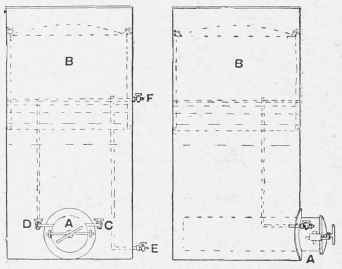
Acetylene Gas Generator.
Continue to:


My Books

