


Wood-Carving And Light Carpentering. Part 2
Description
This section is from the "The American Girl's Home Book of Work And Play" book, by Helen Campbell. Amazon: The American girl's home book of work and play.
Wood-Carving And Light Carpentering. Part 2
Of carpenters' tools all that you would require would be a medium-sized saw, a spokeshave (which answers the purpose of a plane, and is much easier to use), a few rasps and files of different sizes (not forgetting a triangular one for sharpening the saw), and a wooden mallet, weighing about two pounds, though this, properly, is more of a carving than a carpentering tool. Half a dozen of small gouges, a couple of larger ones for rough work, and one or two flat chisels, will be ample to begin with. Chisels are not so useful as gouges; but it is better to get some, as there are cases in which they are necessary, such, for instance, as cutting a perfectly straight line. For scooping or cutting away the wood, a very slightly fluted gouge, about one-fourth inch wide, is the best, unless you are using a mallet; in which case your tool must be a size larger. Accustom yourself to work as much as possible with a mallet; for, though at first you may find it a little awkward, you will soon get into the way of using it, and it will save you much unnecessary labor. The size of your gouges should vary from one-eighth to three-fourths of an inch in width. Do not buy any curved or crooked fools (spoonbits is the technical term for them); for although they may appear convenient, and easy to use, they are not so in reality, and, moreover, give more trouble than they are worth, on account of the difficulty of resetting them. You can get the tools without handles, if you prefer it, and make them at home, which is a much cheaper plan. But take care that the handles be small and smooth, otherwise they will gall your hands. Many carvers prefer using short tools: but this, we think, is a mistake; for, naturally, the nearer you are to your work, the greater strength is required, on the lever principle, which made Harry, in "Sandford and Merton,"prefer the long stick to the shorter one when rolling his snowball.
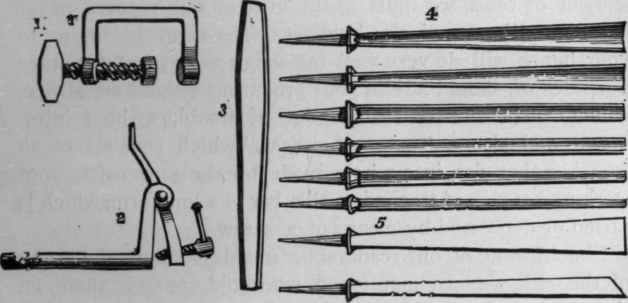
Fig. 126. - Tools, 1. Vice. 2. Holdfast. 3 Handle. 4 Gouges. 5. Chisels.
And now, having provided yourself with these necessary tools, the next thing to be thought of is how to keep them sharp and in good working order. For this purpose you will require a small grindstone, about eight inches in diameter, fitted with a handle, and turning in a water-trough of either wood or iron. In addition to this, you will want a few slips or pieces of common freestone, and three or four hones, varying in thickness to suit the sizes of the gouges, which are shapened by being rubbed on the round edge of the hone, which should be moistened with oil or water; but the freestone is more efficacious when used dry. You will find the task of grinding and setting your tools one of the most difficult parts, and certainly the most tedious part, of carving. It is, however, a difficulty which must be overcome ; for, until you learn to depend wholly on yourself in this matter, you can never become a good carver. Your tools would be unfit to use, were you to trust them to a common cutler to be reset, for he would treat them as if they were carpenter's tools, and grind them with a sharp edge on the outside. This would be quite wrong; for the broad rule to follow in regard to carving-gouges is always to grind the upper or concave side, leaving the convex part untouched until quite the last, when it may be passed over the hone or razor-strop a few times to set the edge. When finished, the gouge should be in the shape of a thumb-nail; that is, with the corners sloping slightly away, but not rounded. Before leaving the subject of tools, we must again urge on our readers never to carve without a vice or holdfast. The screw belonging to your bench will do very well for rough work; but for other purposes we should advise your procuring a small metal vice, which can be screwed to the edge of a table without injuring it, and also a"patent holdfast,"which consists of an iron bar that fits into a hole made for the purpose in your working-bench. Attached to this bar is a long arm, which is raised or depressed by means of a screw.
Should some of our readers be unable to buy all or any of the tools we have mentioned, we would not have them, on that account, be discouraged, for where there is a will there is a way; and we have seen much beautiful carving executed by untaught artists by means of the rudest and scantiest tools. Conspicuous amongst the wood-sculpture in the London Exhibition of 1862 was an altar-piece in bas-relief, after an old picture, - the work of a man who had been formerly a shoemaker. Although endowed with a remarkable genius for carving, yet, being very poor, he was for some time without the means of providing himself with the proper tools. But he overcame this obstacle by tempering and grinding some of the awls which he used in his shoemaking business; and in this manner he contrived some very passable tools, and with them he carved several beautifully finished bas-reliefs. So fine and minute were they, that only by the aid of a magnifying-glass could the extreme delicacy of the work be appreciated. In the early life of Correggio we find another remarkable instance of talent and perseverance overcoming all difficulties. We read, that when he was quite a little fellow, on being sent one day into the forest to cut firewood, he astonished his parents by returning home, not, as they expected, with a load of fagots, but carrying instead a roughly carved figure of the Madonna and Child, which he had fashioned out of a log of wood; his only implement having been a common knife. To those who, like Correggio, are short of tools, we would suggest that a ten penny nail makes a very fair substitute for a chisel, if heated red hot, and then plunged into cold water to temper the iron, and afterwards ground into shape, and fitted with a handle. This is one of many contrivances for supplying the place of regular tools, which will, no doubt, occur to the needy and ingenious carver. Very little decided advice can be offered touching raw materials, - wood, etc., - as so much depends on the style of carving which your talent and inclinations lead you to prefer. Ebony, box-wood, holly, and lignum-vitae are all hard, close woods, and as such are well suited for small objects demanding great delicacy oi workmanship. The only drawback to woods of this kind is the extreme difficulty of procuring them in large pieces tolerably free from"shakes,"which is the technical term for cracks; and they are also more expensive than American-grown woods, being chiefly imported. Ebony and box are usually sold by weight. The former is about twenty-five cents per pound, and the other somewhat less. Any good turner would probably have a supply of these hard woods, which are used chiefly in their trade. The wood usually employed by foreign carvers, but especially the Swiss, is walnut, or lime-wood stained brown in imitation of walnut; but a really artistic workman would scorn the notion of staining or varnishing his work. The latter practice is especially objectionable, as it fills up the interstices, and takes off the sharp edges, which constitute the chief beauty of good carving. The only application admissible is a little oil rubbed in with the hand or a hard brush. As to coloring, it is sometimes necessary, if you are engaged in repairing or adding to any old oak carvings, in order that your work may match the original. But what we object to is the trickery of passing off deal or any common wood for oak or walnut. It never has the desired effect, for any one can detect the sham. Deal is by far the worst wood you can use, as from its extreme softness it is very difficult to make a clean stroke. Do not take any Swiss carving, even of the best description, as a model or guide; for though, when seen from a little distance, it may seem very good, yet on closer inspection a critical eye will discern many flaws and imperfections. For if it be possible to glue or nail on any part, rather than take the trouble of carving it out of the solid piece, these Swiss workmen will do it. It may seem unkind to blame these poor people, whose bread depends on the sale of their knick-nacks, yet we must say that such a dishonest style of work cannot be too much deprecated and avoided. It is, in fact, what a good workman would describe as"scamping,"which is a most expressive word, signifying work of any kind, whether carving or other, that is slurred over by a dishonest person, a"scamp,"who, instead of doing his business honestly and thoroughly, will not work a stroke more than is absolutely necessary. For large pieces of carving, walnut-wood is very suitable and handsome; but in many respects it is not to be compared with oak, which in point of effect, and pleasantness to work upon, is the best wood we know. It is also especially fitted for all descriptions of ecclesiastical carving : indeed, little else is employed for that purpose. American oak is considered the best by professional carvers; as it is of a more uniform color than English, of a closer grain, and less liable to flaws or knots. American walnut is also preferred, for the same reason. In choosing and preparing wood which you intend for immediate use, be very careful to select that only which has been thoroughly shrunk and seasoned : otherwise you will have the vexation of seeing your work warped and cracked before you have half finished it. For this reason it is always advisable to have a stock of wood by you, for then you will insure its having been kept a sufficient time. And, even should the block from which your piece be cut have been seasoning for years, it is safer to prepare the wood a month or two before it is required, as a sudden exposure to the air will frequently cause freshly sawn wood to open slightly. A dry outhouse or cellar, where the sun cannot penetrate, is the best place for your store.
Continue to:


My Books

