


White Pink
Description
This section is from the "The American Girl's Home Book of Work And Play" book, by Helen Campbell. Amazon: The American girl's home book of work and play.
White Pink
The white pink is very easily and accurately modelled in wax. The petals are bloomed on both sides, and slightly tinged with green in the centre of each petal. There are five of each (Figs. 1, 2, 3, 4, 5), which are put round a stalk, from the top of which spring two long white stamens, curling back, as in this figure.

Fig. 117. - White Jasmine.
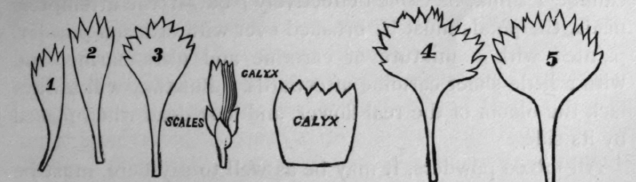
Fig. 118.-White Pink.
The petals lie exactly behind each other (five in each row), and must be securely bound to the stalk with strips of wax; some being bent, and twisted forward, and some curling back. They are often irregularly shaped; and these irregularities are best copied from the original flower, as they add much to the natural appearance of the wax model. A little frost may be dusted over the flower when finished.
The calyx, of green wax, is lined with white, or with a very light shade of green, and the lining allowed to appear just above the points. Four small scales are put on in pairs, at the bottom of the calyx; and the whole is spotted with brown paint. Buds are formed by closing the calyx over a foundation-bud of solid wax; and the leaves (if any are required) are cut out of a long strip of blue-green wax doubled and creased. They need no wire, but should be rubbed with bloom ; and a little frost should be sprinkled on them to give the powdery appearance of the real leaves.
The picotees, and several of the carnations, can be modelled well in wax. The former must be sprinkled with white powder, instead of bloom, and painted with liquid paint, after nature. And the striped carnations should be made in the same way, in white, or yellow, or orange-colored wax, according to the ground color of the petals. The clove-carnation cannot, I think, be copied effectively ; but, if the attempt is made, the petals must be brushed over with crimson powder, painted with a mixture of carmine and ultra-marine, and with a little sheer carmine afterwards. But they will always lack the bloom of the real flower, and look dead when placed by its side.
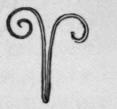
Fig. 119.
All mixed powders, it may be as well to say here, must be well rubbed together with the palette-knife, so that they may be thoroughly incorporated before they are put on the petals.
Continue to:


My Books

