


The Art And Skill Of Lawn Tennis. By A Member Of Prince's Club, London
Description
This section is from the "The American Girl's Home Book of Work And Play" book, by Helen Campbell. Amazon: The American girl's home book of work and play.
The Art And Skill Of Lawn Tennis. By A Member Of Prince's Club, London
Lawn tennis, when it was first introduced, was a mere pastime, involving little more skill than battledoor and shuttlecock. None of the science exhibited in cricket, croquet, or billiards, was required. The game has, however, progressed rapidly. Every succeeding tournament at Wimbledon has witnessed the introduction of some new play, until the game promises to become more scientific than any of its predecessors. The previous chapter, taken from"Harper's Bazar,"No. 44, vol. xiii., contains a full description of the rules and details of the game and a drawing of the court. Some slight alterations have been made in the service-courts and in the rules, to which we shall refer; but in all other points the description there given holds good. It is now proposed to supplement our former article by some practical observations on the science and skill of the game as now played; the object being twofold,-first, to assist beginners to adopt the best form and style; and, second, to enable our readers to thoroughly appreciate the beauty of the game when they participate in it as spectators only.
Holding the Racket. - For ordinary play, the racket should be held short, in fact, close up to the body. It should be grasped vigorously; the muscles of the wrist and fingers being firm, not limp. Many a miss is made from this cause. For instance, when taking a volley, or swift ball, the racket is knocked back in the hand, or partially turned, the ball expends its force without rebound, and the force of the stroke is lost, causing the ball to drop into the net. With a firm grip, much less force need be put into the blow from the shoulder.
The Serve. - There are three serves, - the high serve, the overhand serve, and the underhand serve. The high serve is made at the full stretch of the arm over the head. Sometimes the ball is thrown up, and struck as it descends. The difficulty in that case is to throw it up perpendicularly. Beginners who want to adopt this play should practise tossing the ball up until they can do so with perfect accuracy. It should fall in a line with the striker's right arm. The overhand serve is made with the racket held above the wrist. The ball is held in the left hand, about level with the shoulder, and dropped on to the face of the racket in the act of striking. If the ball be struck with the racket slanted to about thirty degrees, and very hard, it will give two motions to the ball, - a forward movement and a rotatory motion, thus: -
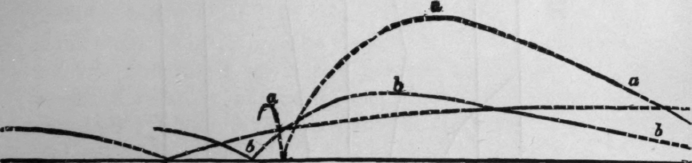
Fig. 39.
This is called putting cut on the ball, and is a very puzzling play to a beginner. The ball, on falling, will rise abruptly, instead of following the normal angle. (See line a a a, Fig. 39, representing a cut service.) The overhand service, if served with the racket face perpendicular, or nearly so, imparts a twist to the ball; so that as it pitches it will twist away to the adversary's right hand. (See Fig. 40. Line a a a represents an overhand serve.) An underhand serve is played by turning the body of the racket downward. Some players stoop, and serve as near the ground as they can. If this stroke be neatly played, it will give a left-hand twist to the ball. (See Fig. 40, line b b b.)
The server mav stand anywhere on the base-line. If he serves from K (see Fig. 40), he can send an oblique ball with an outward twist - very difficult to return: if from I (see Fig. 40), the line will be more longitudinal to the court; but swift serves are safer from this point, as less likely to pitch out of court. Some players, however, prefer K. In Fig. 40 the footmarks denote the position of players' feet when serving or taking.
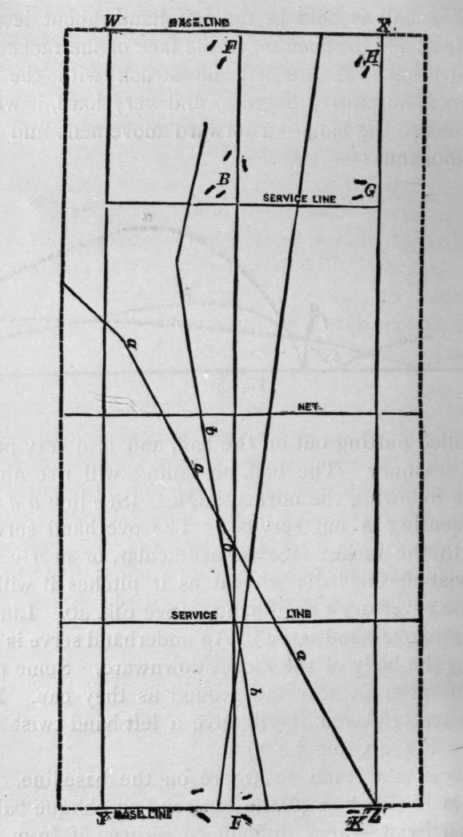
Fig. 40.
The Take and the Return.-When a ball is served, the striker-out should stand in the opposite corresponding court. If the serves are slow, B and G (Fig. 40) are the places; if swift, F and H. It requires great skill to judge where a ball will pitch, and how it will bound : nothing but practice will give it. It is a subtle sense of twist and momentum, which cannot be explained. Watch for an overhand or underhand serve, and proceed accordingly. If an overhand twist, it will be to your right; an underhand, to your left. When taking a ball, recollect that the right moment to do so is when it has pitched, bounded, and, having exhausted its momentum, is about to fall, thus : -
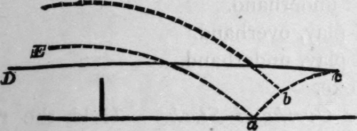
Fig. 41.
The ball will leave the racket at an angle equal to that of the incidence; so that, instead of returning close to the net, you will lob the ball up in the air. If you take at the point c, the ball, having lost its momentum, will follow exactly the line of your stroke, c D.
In order to take the ball well, you should be abreast of it: it should be between you and the side-line of the court, at a right angle. Then, with the left foot forward, and the right foot back, swing the shoulder well round, taking plenty of time to the stroke. More mistakes are made by being too soon than too late. In fact, whenever you can, let your racket hover (be it only the millionth part of a second) before you strike. There will then be no force in the stroke, save that intended for the ball. If you have to run forward for a ball, recollect to deduct the force of the run from the force of the stroke: otherwise you will strike out of court. The blow you give should be as much as possible from the shoulder ; and you will find, if you try, that you can graduate the force of a stroke so given with much more delicacy than that of one from the wrist.
All the strokes played at tennis may be resolved into the following: 1. The fore overhand.
2. The fore underhand.
3. The high stroke.
4. The back overhand.
5. The back underhand.
6. Forward play, overhand.
Continue to:


My Books

