


Part Third. Occupations For Play Or Profit. Chapter I. Sewing And Doll's Dress-Making
Description
This section is from the "The American Girl's Home Book of Work And Play" book, by Helen Campbell. Amazon: The American girl's home book of work and play.
Part Third. Occupations For Play Or Profit. Chapter I. Sewing And Doll's Dress-Making
Sewing as it is generally learned is always a great bug-bear to a child, who is often made to sew an hour or more on a dreary"over-and-over"patchwork-square. The sewing-schools in our great cities have come to be much more cheerful places than the room at home where tired and fretful little bodies knot their thread, and grow crosser and crosser with every stitch. In the sewing-school there are songs that describe all the things that must be done, from a hem or a fell to a patch, and a set of questions to which answers are made in concert; Mrs. Louise J. Kirkwood's little sewing-primer giving them all, with many hints that mothers or older sisters would do well to copy. Any little girl must be patient, and willing to learn ; but very soon she will take real pleasure in her work, above all when it comes to Christmas or birthday gifts, or to doll's dress-making. Here are some hints for the teacher.
If a child does not succeed satisfactorily at first with an over-and-over seam, do not insist upon keeping her at it until she is exact. She will have to sew upon many a patch, perhaps, before she can make the stitches small, even, and close. But try her with a hem or a back-stitch : she will be growing used to handling the needle; and, after one or two trials of this sort, she will go back to the over-and-over seam with fresh interest.
Straight Lines. - Draw a line with a lead-pencil on the strip of muslin which has been hemmed, and, with the needle threaded with red cotton, show her how to stitch along the line. The red cotton will be a novelty, and the pencil-mark a new feature : she will be very likely to follow it to the end with real pleasure.
Outline Pictures. - Draw some straight lines in the form of a house or a barn, make the outlines of a crooked tree by the doorway, make a chicken with two or three flowing feathers in its tail, make a man with a rake in his hand, above all things make an old lady with a high cap on and a cane in her hand, and you will never have trouble to keep the little ones busy.
They will very cheerfully hem round a square in the most painstaking manner, they will even struggle patiently with a fell seam across it, if at the end you will but promise to draw a dear old grandmother with a cap and cane, that they may stitch.
Then, too, you may write the child's name and age in a fair, clear hand : you may add a motto, or some short line.
Get her to hem in a neat patch in a piece of cloth : she will be proud to stitch her initials on it. Any thing of such personal interest she will work at very gladly, and will all the while be growing more and more skilful with her needle, and captivated with its possibilities; thus travelling, if not a royal road to knowledge, at least a very pleasant one.
A child who has learned all the forms of plain sewing, and wants to do nice work for her dolls, ought to have good sharp scissors, a low table or little lap-board for cutting, plenty of pins for pinning patterns to material, and a well stocked work-basket,-all on condition that everything is kept in order in its place. The chair must be low, so that the feet rest comfortably on the floor; and hands and nails must be clean, so that the thread need not be blackened. In plain sewing, the stitches used are overhanding, hemming, running, back-stitching or stitching, gathering, overcasting, buttonhole, herringbone, feather-stitch, and darning.
Work should always be carefully basted; as, if this is not done, the sewing will pucker it, and probably it will have to be ripped out. In the sewing-primer already mentioned, the questions and answers include a careful description of every stitch, cuts of which are given here.
A doll is a nice present for any child, but is worth far more if prettily dressed, and, above all, not only with clothes that can be taken off easily, but with plenty of them ; so that dolly can have her own little washing and ironing, and her bureau-drawers or trunk in beautiful order. Nightgowns are often forgotten, and the poor dolls obliged to sleep in their clothes. We begin, then, with the nightgown ; the little diagrams given here being hints for the shape. Patterns for doll's clothes are sold now in several sizes by the pattern manufacturers, and can be had of the Domestic Sewing-Machine Company, and several fashion magazines,"Harper's Bazaar,"and others.
Nightgown. - Get some fine cotton cloth to commence with, Lonsdale cambric being the best. Always use fine stuff of every sort; for, the dolls being so small, the clothes sit very badly if made of thick material. Cut out the front and back, as at Nos. 1 and 2 ; then the shoulder-piece, No. 3; then run the front and back together under the arm, gathering the back into the shoulder-pieces; then join them over the shoulder; then put on them a small, narrow band, slightly gathering the fronts into it, putting the pieces at the back in plain ; and then the sleeves, No. 4. The trimming is, of course, according to fancy. Some insertion up the front, with very narrow ruffles up each side, looks very nicely, also tatting or crochet: indeed, any thing of the sort. But it certainly looks better trimmed. A great improvement to the nightgown is to cut the fronts too broad across for the doll, and run narrow tucks down to the waist; but this is, of course, more difficult, as the tucks want to be run very evenly.
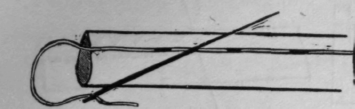
Fig. 52.- Basting.
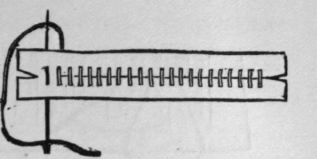
Fig. 53. - Overhanding. Showing the seam opened, and on the right side.
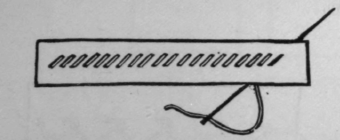
Fig. 54. - Hemming.
Showing the stitches on the right side of hem, with the needle in position.
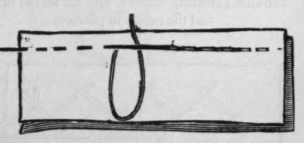
Fig. 55. - Running. Showing running-stitches, with the needle in position.
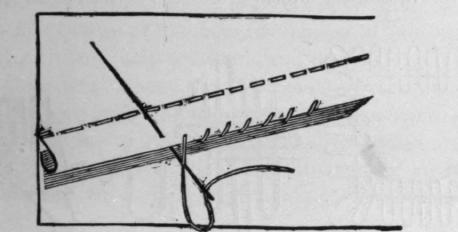
Fig. 56. - Felling. A fell seam, showing the first line of sewing finished, the edges turned under, and partly hemme
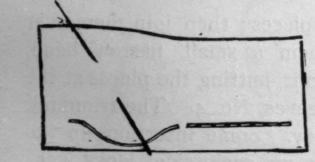
Fig. 57. - Stitching.
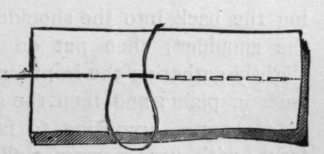
Fig. 58. - Back-stitching. Showing the needle in position.
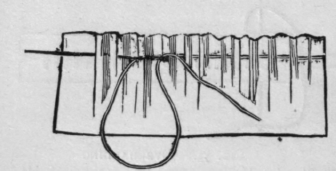
Fig. 59. Gathering. Showing gathering stitches, with the thread drawn, and the needle in position.
Continue to:


My Books

