


Part Second. Outdoor Games. Chapter I. Lawn Tennis And Its Laws
Description
This section is from the "The American Girl's Home Book of Work And Play" book, by Helen Campbell. Amazon: The American girl's home book of work and play.
Part Second. Outdoor Games. Chapter I. Lawn Tennis And Its Laws
This deservedly popular game is not of mushroom growth, but is rather antiquated ; as it can be traced to the introduction of tennis into England, by certain"persons of superior rank,"in the sixth year of the reign of Henry III., or about 1222, as an amusement well befitting the tastes and inclinations of the nobility, in the performance of which they could exercise a commendable zeal, as also their whole physique. Tennis undoubtedly came from France, where it had been played many years prior to its introduction among the worthy sports of our English ancestry. There are not a few, however, who most tenaciously hold, that, in some modified form, it existed among the sports of Rome as far back as the time of Nero. The name is in all probability a derivative from Tennois, a place in France, in the district of Champagne, which, by a perversion of the first letter, is now written Sennois, where balls were manufactured, and, it is claimed, the game first introduced.
As played in that ancient day, ornamental and in some cases very elaborate and expensive courts were constructed, usually 96 or 97 feet long by 33 or 34 feet wide, provided with a net hung across the middle, parallel to the shorter sides of the parallelogram, over which the ball must be struck to make any stroke good. This net divided the court into two sides, known respectively as the service side and hazard side. There were some marked features of this game, from which the play as we at present have it has been a severe divergence.
The essentials to a thorough enjoyment of this game are not so many, but the few should be carefully selected.
Those who share in the game should possess themselves with a large stock of good nature and untiring zeal. Nothing so effectually mars the pleasure of an afternoon's sport as a momentary burst of ill-directed temper. Disappointments and failures should work a renewed determination to excel, rather than lead to sulks and disheartenment. The latter unfortunate disposition in one is sure to mar the enjoyment for the remaining associates.
A lawn, as is indicated by the name, is the first essential to pleasurable play. This should have its grass well clipped, and the turf evenly rolled. The courts should be laid off rectangularly, as indicated in the diagram. Experience has taught that it is best to get up the game with a reference to the direction of the wind, the net (A B, see diagram, p. 153) being set at right angles to it. Thus will be avoided in great measure the tendency of the air-currents to carry the balls off or beyond the bounds, and the play will be then against or with the wind. In either case, its influence can be more accurately calculated.
The lines of boundary and division should be indicated upon the greensward by means of whitewash carefully laid on with brush and string. The larger or double-handed court should be 78 feet long by a width of 36 feet inside measurement; and the smaller or single-handed court, 78 by 27 feet inside measurement. As in the old game of tennis, so in this, the court is divided across the middle, and at right angles to its greatest length, by a net (A B) so stretched and fastened to and by two posts (A and B) standing 3 feet outside of the side-lines F H and G J, that the height of the net at each post for the double-handed or larger court is 4 feet, and in the middle, over the half-court line at C, 3 feet 6 inches; and, for the single - handed or smaller court, 4 feet 9 inches at the posts, and 3 feet in the middle, over the half-court line. These divisions are termed courts, and are subdivided into half-courts by a line (D E) midway between the side-lines, and running parallel with the greatest length, which is known as the half-court line. The four resulting half-courts are respectively divided by a line on each side of the net (K M and N P) parallel to, and 22 feet from it. These two lines, called service-lines, it may be observed, will then be 17 feet inside of the lines of boundary for the short sides (F G and H J) known as base-lines.
The implements comprise net, posts, cordage, balls, and rackets. The most substantial of these will be found to give the greatest satisfaction. Any one with a medium amount of ingenuity can make a net, for which a careful choice should be made of the cord, that strength, and lightness of weight, may be secured, thus enabling a better drawing of the net to have it taut. The posts will be more rigid, and appear with better grace, if turned without a joint in their middle; but if, for convenience in packing, it is desirable to have the joint, care should be taken to have it so adjusted, that when set it will be straight, and not, as too many, alas ! are, with so great a"kink"as to look more like the hind-leg of a dog than the thing of beauty it should be.
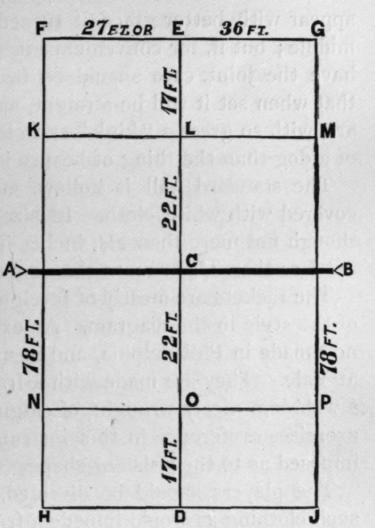
Fig. 38. -Plan of Ground.
The standard ball is hollow, made of India-rubber, and covered with white cloth. In size it must be at least 23/8, though not more than 21/2, inches in diameter, and of weight not less than 17/8or more than 2 ounces.
The rackets are mostly of foreign manufacture, and usually of the style in the diagram. An excellent racket, however, is now made in Philadelphia, and in use, with great acceptance, at Yale. They are made with a frame of elastic wood, with a webbing, nicely wrought, of catgut. The individual player exercises preference in this instrument, as no restriction is imposed as to their size or shape.
The players should be divested, so far as practicable, of such clothing as would impede a free and rapid movement of the muscles, especially those of the limbs. Greater security of person, and accuracy of movement, will be attained if the feet be shod with almost any of the many devices for this purpose. The shoe should be of a pliant material (a soft canvas is found substantial), soled with corrugated rubber for the ladies, and spiked for the gentlemen, nearly or entirely without heel.
Continue to:


My Books

