


Large Garden Rose
Description
This section is from the "The American Girl's Home Book of Work And Play" book, by Helen Campbell. Amazon: The American girl's home book of work and play.
Large Garden Rose
The rose-petals are to be cut out in circles made up of five petals each. Three of No. 1 are required, and two of a size smaller, and one of the smallest size, which can easily be graduated from pattern No. 1.
They are veined in the centre of each petal, and modelled in the hand with a moulding-tool, so as to round them like rose-petals. The smallest circle is closed up, and the petals are glued together; one edge of the petal being placed over another petal, and so on. The circles must be modelled so that all but two of No. 1 are hollowed in the inner side : these are moulded so as to turn back, and are not so much hollowed as the others. When the rose is formed, the stalk, with a little knob for the head, must be pushed through the small circle, and securely fastened to it (a large rose will require a wire within the leather stem); and the other circles must be pushed up in their turn, observing that every petal is placed behind and between the two front ones, and glued on to the inner circles. Finish the flower by attaching the calyx and seed-pod to it. It is well to cut out the leaves in the spray. No. 4 is a middle-sized rose-leaf. Buds are made by a circle of five or three small petals glued together, and placed within a calyx and seed-pod ; thorns, by cutting out little triangular pieces of leather, doubling, and pinching them into shape, and gluing them to the flower-stalk.
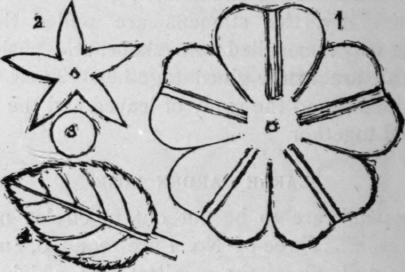
Fig. 105. Large Garden Rose.
1. Rose-petals. 2. Calyx. 3. Seed-pod. 4. Leaf.
The small double roses are done exactly in the same manner, with smaller petals, leaves, and stems. All the pieces composing the spray should be carefully pared at the edges, so that the leather may be much thinner there. The single roses have only one circle of five petals (which should be veined from the real petal, and hollowed into shape), and a bunch of stamens in the centre of the flower. These are made in the same manner as the stamens in wax roses, cut out in a strip of skiver, and rolled and curled by the fingers, and, when dry, rolled round the top of the stalk, and glued neatly to it. The calyx and seed-pod are, of course, the same as for the double roses, and the buds are made in same way.
Very pretty effects may be produced in this way. But there are better uses for leather, which is much more really decorative when simply embossed, or used to imitate fretwork carving, as in the cuts below.
For these designs, cut out two pieces of the required shape, as, for instance, Fig. 1, and glue them together, so as to present two smooth surfaces. When quite dry, the piece thus made must be laid on a board, and the ornament formed, by cutting out the pieces, which would be sawed away in wood-carving, by gouges and chisels of various sizes. These must be held upright in the hand, and the pattern stamped out according to the thin cardboard pattern, which should be laid upon the leather. The gouges used should exactly fit the curves of the pattern, so as to cut it clean.
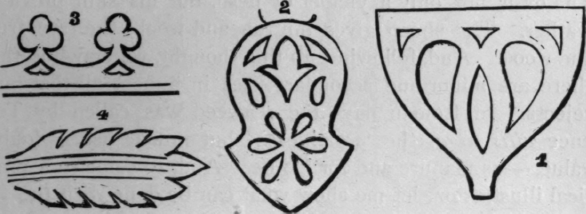
Fig. 106.-Mouldings.
Brackets are made by gluing a number of pieces prepared thus together, over a foundation of wood, and ornamenting them with squares, rounds, and ovals, and mouldings cut out in the same way, and arranged to form an architectural design.
Mr. Charles Godfrey Leland, whose name is now synonymous, with the best work of industrial art schools in this country, has given some suggestions for the use of old tin cans, which have been practically tested, and found to give results which are astonishingly effective, as well as very durable; the articles bearing rough usage, and constantly improving in color.
Continue to:


My Books

