


Chapter V. Cardboard And Its Uses
Description
This section is from the "The American Girl's Home Book of Work And Play" book, by Helen Campbell. Amazon: The American girl's home book of work and play.
Chapter V. Cardboard And Its Uses
Whoever learns to handle cardboard carefully, and to cut out with a steady hand the many beautiful designs that can be used, has taken the first step toward successful wood-carving. But cardboard is far cheaper, and also less troublesome to manage, than wood ; and a girl of any ingenuity can make cardboard furniture for a small doll's house that will imitate perfectly any style they choose. Nearly ten years ago,
"St. Nicholas,"which has done so many good things for children, described in the number for May, 1874, a city of cardboard, called"Christmas City,"in which the tallest buildings were just two inches and a half high, and which had stores, and a bank, and churches, a city-hall and hotel, and a number of public buildings. Later, the maker of this made"Holiday Harbor,"with ships lying at anchor, and storehouses and docks, and a train of cars ready for loading on freight. Cardboard for such uses must, of course, be smooth; that with holes being used only in embroidery, and in a few ornamental forms.
In making a small cottage, there would be seven pieces to cut from the sheet of cardboard, which must first be drawn on it, - a front and a back exactly alike. Two sides, like this, are also to be cut, and then the two halves of the roof, and a little chimney.
In cutting out, lay the cardboard on a board, and use a sharp knife, following the lines exactly. Cut out the windows and doors. For the windows, a bit of mica may be pasted inside for glass, first pasting two narrow strips crosswise for sashes. The window-piece is to be cut in two, lengthwise, pasted each side of the window, and painted green or brown for blinds. A bit of colored paper will imitate curtains behind the sash, if mica cannot be had For the doors, take two very narrow strips of paper, and paste half of each strip on the back of the door, and the other on the inside of the front. When the paste dries, the door
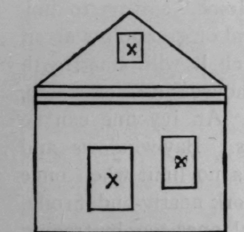
Fig. 96. - Front and Back of Cottage.
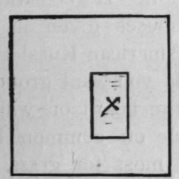
Fig. 97. - Side of Cottage.
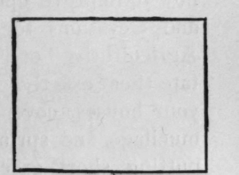
Fig. 98. - Half of Roof.

Fig. 99. - Chimney.
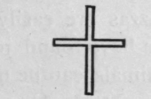
Fig. 100. - Window.
will open and shut. A very narrow strip of dark-brown paper pasted all around the edge of the door will look like a moulding; and a door-knob and bell can be painted. Four little cleats, half the size of a match, must be used in putting the whole together. A cleat is to be pasted to the inside of the front, at each end, and allowed to dry in the sun. When they have dried, wet each with paste, and lay the two sides against them, making the edges even, and letting them dry. The cleats can be pasted to the back while you are waiting for the front to dry, and the roof can then be put on. Paste it together at the top edges, and then paste the top edges of the house to hold the roof when set on. After the roof is firm, cover it with black or dark-red paper. The chimney may better be of wood of the shape given, and pasted also; and the ridge is made by pasting on a very narrow strip of cardboard. Sometimes, instead of cleats, the cuts are made in the cardboard a little beyond the lines given, and the pieces thus made bent down at the lines, and pasted wherever a joining is made. When a simple little cottage has been made like this, it will easily be seen how to improve upon it. A good way is to take the plans and elevations for houses given in such papers as"The Agriculturist,"or"American Rural Home,"and try to imitate them exactly. If you want ground or grass-plots about your houses, cover the board on which it will stand with mucilage, and sprinkle on common house-sand for paths, putting short green moss for grass. An ivy-vine can be made with painted cardboard leaves. Bay-windows and piazzas are easily added; and there is no limit when once you have found just how to do the work neatly and firmly. Animals can be made, and very natural ones too, by tracing the pattern for one from pictures in any natural history; then, following the lines exactly, and painting as nearly like the copy as possible.
With perforated cardboard there are endless uses, from the mottoes which may be embroidered, and by which children may learn some mysteries of shading and stitches, to the beautiful fret-work, which has a real value. This fretwork is done by laying the cardboard on a board, and cutting away, with the point of a very sharp penknife, whatever design has been fixed upon. If any cut meets another, of course the entire piece is carried away, and the greatest care is necessary to prevent this. The finest board must be used. A Maltese cross is made by cutting the size required, being sure that it is begun with an even number of holes; then cut each successive piece one hole smaller on each side, gumming them all together. The last layer will have but one hole. When dry, paste on black velvet, and frame, the effect being almost like carving. A lamp-shade may be made of five pieces, each a third narrower at top than at bottom. Cut an oval space from the centre of each, and fit or paste on a small picture. Then build up a frame, as in the Maltese cross, by laying on pieces, each one a little smaller than the last. Or scallops can be cut around the edge, each piece carefully lined, and the whole laced together with very fine silk cord, little tassels hanging between each. Bookmarks are pretty in fret-work, gummed to ribbon. And there are many ways of using that will occur to every ingenious girl; though let me tell you, in confidence, that such work is best for younger sisters, who enjoy and learn from it; but it has not real beauty and value enough to be done by older hands ; much of it in a room giving a cheap look. Modelling in the plain cardboard is quite another matter, and educates both eye and hand ; but the perforated board may better be let alone after childhood.
Continue to:


My Books

