


Chapter IX. Shells, Mosses, Pine-Cones, Etc
Description
This section is from the "The American Girl's Home Book of Work And Play" book, by Helen Campbell. Amazon: The American girl's home book of work and play.
Chapter IX. Shells, Mosses, Pine-Cones, Etc
In the beginning let it be remembered, that, with shell-work at least, it is not an ornament for the parlor, even the most beautiful shell-flowers having a half-barbaric look. The chief use of shell, pine-cone, or seed work, is in interesting and amusing children, and teaching the neat and skilful handling which later will tell in better work. But many pretty articles can be made, either from shells gathered at the seashore, or from foreign ones, which can be bought of all sizes, the smaller ones by the ounce. For all who would learn the intricacies of the work, there is a manual, the title of which is given on p. 411.
Where a shell bracket, a handkerchief-box, or a basket is to be covered with shells, a cement is made on purpose, which can be bought at shell-stores, or made at home by mixing equal parts of gelatine, white lead, and plaster-of-Paris with just enough water to make the whole like putty. It becomes as hard as earthenware when dry. In using it, put a smooth, even layer on the article to be decorated, and stick the shells into it in any pattern you like. Any dry color may be added to tint it red, blue, or yellow, as desired. A bracket can be cut from heavy pasteboard, sewed together, and then covered with shells; and a watch or wall pocket, and other articles also can be thus made. Fill in all vacant spaces with the smallest shells. If they are not perfectly clean, boil them well, and brush with a little brush. The strong smell about them can be taken away by washing them in a solution of chloride of lime, one tablespoonful to a quart of water.
Periwinkle, or large mussel-shells, make pretty pincushions. Stuff a bag, cut just the right shape, with either bran or emery; cover it with silk; glue the inside of each shell, and press against it till dry. Clam-shells may have little landscapes painted on them ; and the dark blue spot in the inside of an oyster-shell can serve as the bearskin cap for a soldier painted below.
Mosses for wall decoration should be carefully dried. A small basket of graceful shape may be cut in two, tacked or gummed to a sheet of cardboard, and then filled with brilliant lichens, trumpet moss, and the lovely coral moss to be found on old fence-rails, or often on rocks covered with the white mountain moss. Best of all is a large plate - a soup-plate perhaps - filled with the bright green moss growing in shaded places in the woods. Cover it with a bell-glass, and water very seldom, as the glass keeps in moisture. As spring approaches, you will be surprised to see what developments take place, for seeds have been biding their time, and you may get almost any thing from partridge-berry to liverwort.
Pine-cones, both large and small, may be used in many ways. The smaller cones, mixed with acorns, seed-vessels, lichens, and bits of bark, will cover a rustic basket for plants, which may hang in the window, or be mounted on a stand. A round wooden bowl is best for this purpose, and the rustic-work should be glued on securely, and varnished when dry. Picture-frames are made in the same way; and work-baskets may be cut from stiff pasteboard sewed together, and then, when covered with rustic-work, lined with silk, and furnished according to taste. Wall and watch pockets, brackets, and many other articles, can be made, and are of much more real worth and beauty than any thing in shell-work. For a lawn flower-box, saw half a butter firkin in two, and either cover entirely with cones and bark in any design you like, or drill holes in the top of the cones, and pass a zinc wire through each one; then festoon a rope around the tub, and hang the cones upon it, filling in all the spaces with bark or lichens, and varnishing rope and cones. Often a coat of pitch is given to the whole, inside as well as out.
Beautiful brackets can be made from the large fungi growing on trees in damp woods, which can be screwed firmly to an oak or walnut back, and need no varnishing.
Straw and splints for weaving wall-pockets, or for basket-making, or straw mosaic-work, can be bought at any fancy-store; but while the"castles-in-the-air"hung from chandeliers are a good occupation for a child, they have not sufficient beauty to recommend them to older people. In making straw baskets, cardboard foundations are used; little holes being punched in the oval or circle, about a quarter of an inch apart, the straws being just touched to thick mucilage before they are set in place. Ribbon must then be woven in and out till the right height is reached; and, as an edge, either a piece of ornamental straw braid, or of chenille matching the ribbon, may be sewed on. Match-boxes, etc., are made by gumming the straws to a cardboard shape.
It is impossible to more than suggest what may be done in the direction of fancy-work; and the whole field of ornamental needle-work, of knitting, crochet, tatting, china-painting, illuminations, and the countless other forms of occupation, can only be referred to. But titles of the best and most carefully prepared manuals on all these subjects are given on pp. 411-414; while every neighborhood, no matter how remote, has at least one devoted worker in these directions, who is always willing to share patterns, and give neccessay hints.
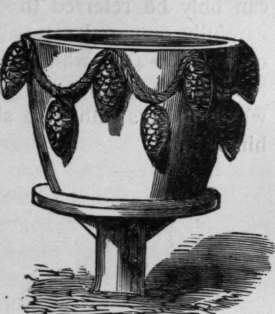
Fig. 125. - Lawn Flower-Box.
Continue to:


My Books

