


A Spray Of Ivy-Leaves
Description
This section is from the "The American Girl's Home Book of Work And Play" book, by Helen Campbell. Amazon: The American girl's home book of work and play.
A Spray Of Ivy-Leaves
This is, perhaps, the most easily modelled spray to begin with; and any patterns of leaves may be obtained by putting the real ones on paper, and tracing round them, and copying the veinings. Place the paper pattern on the leather, and cut it out in the whole spray. Pare the edges with the knife on the under side of the leather, so as to make the leaves and stalks thinner at the edges; then dip the spray in cold water, or put it on the board, and damp it thoroughly with a wet sponge. It must not be too wet, or it will be swollen by the water; but while dry it will not receive the impression of the veiner, neither can it be moulded into shape. The veining is to be done by pressing the small veining-tool on the front side of the leather, and drawing it down and across the leaf with sufficient force to give the markings of the real leaf. The middle vein is made by double lines. When all the leaves have been veined, they are to be modelled into shape, and curled, as in nature. The leather leaf should be held in the left hand, and the under part of it pressed with the thumb and second finger of the right hand, while the forefinger presses it on the top, so as to push the leather up between the veins, and to curl the edges over. The middle stem and the leaf-stalks must be laid on the board, face downwards, and rolled with the palm of the hand till they are quite round. They will not require wire. When quite dry, they will retain their roundness, and the leaves will keep their shape and the impressions of the veining-tool. In order to make them firmer and stiffer, it may be as well to put a coating of glue over the under part of the leaves, and to glue up the stems into close, round stalks. The berries of the ivy are made by pushing small circles of the thin part of the leather into little round holes in the small mould
(well wetting them first), and moulding them by turning the smallest pestle round and round in the hole. They are pulled out of the hole in shape, and left to dry; after which they are trimmed, and glued on to the circles made for them on the spray. The five outer berries are cut out on the branch, and must be moulded also. Holly-berries, currants, and small grapes, are made in the same way, in moulds of various sizes. The spray is now ready to be glued to the wooden frame on which it is to be mounted, which, if not entirely concealed by the leaves, must be prepared by a covering of the thin skiver glued over it. The leaves and stalks must be glued on firmly over this ; and it is best to secure them in their places by the pins, which are hammered a little way in, and these can either be withdrawn when the work is quite firm, or the upper part of the pin may be broken off with the nippers, and the point left in the frame if it will be concealed by the leaves. The glue must be kept very hot while in use, and in a moderate degree of consistency. If it is too thick, it cannot be laid on smoothly; and, if it is too thin, it is apt to stain the work. Especial care must be taken to avoid glue-stains when the work is left uncolored and unvarnished ; and this is generally the case in the present day. It is found, that the leather left in its original condition becomes of a very nice artistical color when long exposed to the air, and is better unstained by any preparation of paint or varnish.
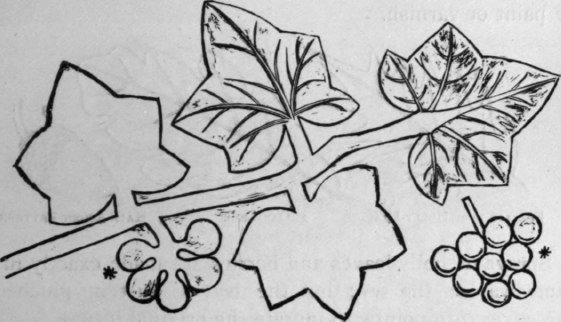
Fig. 101. - Ivy-Leaves. * The same moulded and filled up.
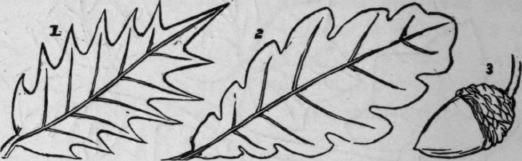
Fig. 102. - 1. Holly-Leaf. 2. Oak-Leaf. 3- Half-Acorn Pattern.
Sprays of holly-leaves and berries are made exactly in the same way as the ivy; but the leaves must be pinched at the edges into points, to imitate the original leaves.
The acorns are best made by covering the real acorns with skiver: but, if these cannot be obtained, they must be cut out in halves, like the pattern, moulded, and stuffed with cotton-wool; and the cup must be very much pricked, snipped, and indented, to give the rough appearance of the original. The half acorn alone will generally be sufficient to glue on a frame or bracket, etc., unless it is to be pendent ; in which case, of course, the whole acorn will be needed, and it would be best to cover one separately from the cup, and glue into that. Nuts and filberts are made in the same manner, and fastened into a thin leather involucre, cut out from the original, and jagged in the same way. Pendent grapes are made in a similar fashion; but, for these, little wooden moulds of light wood are required. They are covered with skiver made very wet, and drawn closely round them, and tied with cotton at the stalk-end. As soon as they are quite dry, the cotton is taken off, and the leather cut away, so as to leave a smooth point ready to be attached to the stalk, or be glued into the bunch. The grapes that are not pendent are made in the moulds, in the same way as the ivy and holly berries, and glued on a piece of leather; the lower ones concealing the foundation, and the others being piled on, one half over another, so as to form a compact bunch of grapes of various sizes. The branch, leaves, and tendrils of the vine, must be very carefully modelled, veined, and rolled. The broad strip of leather cut out for the stalk is to be very much veined, wrinkled, folded, and twisted, to represent nature. It is impossible to describe its manufacture accurately; and it can hardly be done without a pattern, or the real branch to model from. The tendrils should have a vein drawn down the under side, so as to make them curl over more easily; and then they are rolled and glued like the flower leaf-stalks.
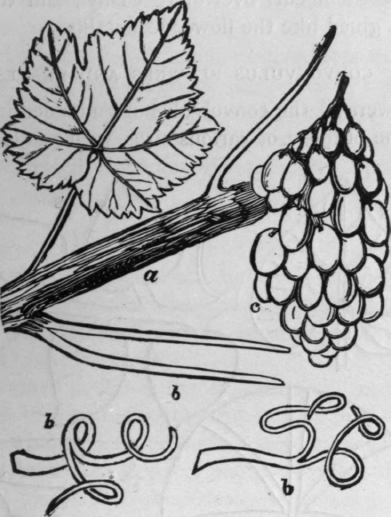
Fig. 103. - Vine Leaf and Stalk. a. Stalk, b, b, b. Tendrils c. Method of doing the grapes.
Continue to:


My Books

