


Mountain Climbers
Description
This section is from the book "How To Build Games And Toys", by B. W. Pelton. Also available from Amazon: How To Build Games And Toys.
Mountain Climbers
A bean-bag tossing game which will absorb players of all ages is illustrated in Figure 5.3. It represents a race between two expert mountain climbers who have planted their flags at the summits of twin peaks and, as the game opens, are in a dead heat at the start of the perilous descent. As everyone knows, it is often just as difficult to climb down as up, particularly if one is fatigued. Added to this are the dangers and setbacks encountered during rain, sleet, and snow.
As indicated in A, the top of the plywood panel is cut irregularly to a depth of 4 or 5 in. to represent twin peaks of equal elevation. Commencing 3/4 in. from the bottom, furring strips are nailed flush with the side edges of the panel to provide sufficient thickness for mounting the target hinges (see Figure 5.3 C); to save lumber, one furring strip can be ripped into 3/4-in. strips. A horizontal strip connects these side members at the top.
Two 5/16-in. holes are then bored 71/2 in. from the sides of the panel, and 5 in. down from the tops of the peaks. From these, two parallel slits are cut a scant 5/16 in. wide down to within 3 in. of the bottom edge. Sand both edges of the slits with a strip of fine sandpaper to insure smooth descents by the two sliding figures.
Next cut the three penalty holes down the center of the target. The lower, 5-in. "Rain" hole is 5 in. above the "Winner" line; the others are spaced at 5-in. intervals. Tack colored cloth pockets to the rear of the holes.
The hinged back braces B are isosceles, triangles with 26-in. sides on 14-in. bases, cut from plywood at least 1/4 in. thick. They are hinged to the back side strips as in detail C.
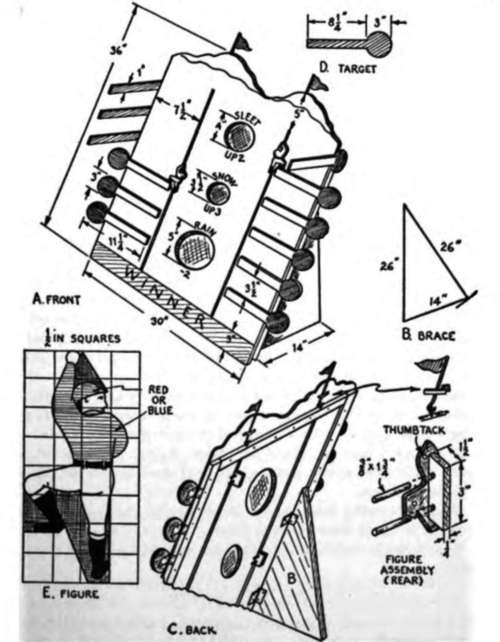
Fig. 5.3. Mountain climbing race.
Twelve targets with 3-in. circular disks on 81/4-in. tongues, 1 in. wide, are cut from 1/4-in. plywood as in D. Each one is hinged to the front panel so that the horizontal tongues are 31/2 in. apart. The two flags, one red and the other blue, are attached to wire staffs which are bent into circles at the ends, so that they can be swiveled to screweyes on the top cross member as indicated in detail C. A bent spring clip holds each one erect during play, after which they can be laid flat for storage.
The figures of the two climbers are jigsawed from 1/4-in. plywood scraps, then bradded and glued to f-in. sliding blocks 11/2 in. wide by 3 in. long. Three or more metal thumbtacks imbedded in the backs of the figures will accelerate their descent. The assembled figures are then fitted into their slots and marks made on the sliding blocks for the 13/4-in. lengths of 3/8-in. doweling which anchor the blocks against the rear of the slots. Obviously, these holes must be set back far enough to permit the blocks and their figures to slide down without binding. The dowels should fit firmly but need not be glued, so that they can be removed for necessary repairs or refurbishing of the figures. Paraffin rubbed along the slots will speed up the action.
The figure with the red shirt and hat should match up with the red flag, and vice versa. All targets on the red side are enameled red, with blue targets for the blue climber. The target panel can be painted a dull gray or brown, with a suggestion of snow on the peaks.
Rules
Three bean-bags are thrown by each player without interruption. If a player feels confident enough to pass up one or more of his shots at his climber's targets, he may throw at any of the three penalty pockets.
1. If a player's bean-bag enters the "Sleet" pocket, his opponent must raise his climber two spaces, restoring the two upper targets to their original "front" position.
2. When a bean-bag lands in the "Snow" pocket, opponent's climbing figure must be raised three spaces or targets.
3. A bean-bag in the "Rain" pocket causes opponent to forfeit two of his three throws.
Continue to:


My Books

