


Please, Won't You Play Outdoors?
Description
This section is from the book "If You Live with Little Children", by Carolyn Kauffman and Patricia Farrell. Also available from Amazon: If You Live with Little Children.
Please, Won't You Play Outdoors?
To dig and delve in nice clean dirt Can do a mortal little hurt.
J. Bangs
Setting
Something to dig in, something to swing on, something to splash in, something to climb on, something to ride on, something to jump on, something to walk on, something to sit on, something to lie down on, something to push, something for creeping and crawling.
Outdoor Play Equipment
Not all people have the same space available for play, and in some cases it may be very limited. Among the suggestions here you will be able to find many that are not dependent upon a large play area.
Something To Dig In. Sand Is Grand
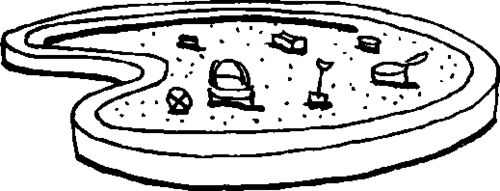
Sandboxes can be any shape or size.
A free form made of concrete can be a wading pool too, if you add a drain.
A sand dune in the corner of the back yard is good enough. A box 6' x 6' is standard.

Sand Toys
Wooden spoons and bowls
Strainers
Colanders
Funnels
Old pans Scoops
Toy cars and trucks
Sand Molds
Measuring cups
Plastic glasses
Plastic or aluminum bowls
Muffin tins
Jello Molds
Children like wet sand. It makes castles taller. Some children like their sand really wet It's a good idea to turn the hose off after filling a few buckets and pans with water.
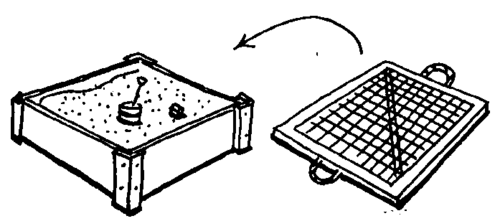
Cats like sand too. Here are some ways to change their minds:
1. Lay a tarpaulin or boards across the sand at night
2. A screen in a wooden frame is light and easy to manage.
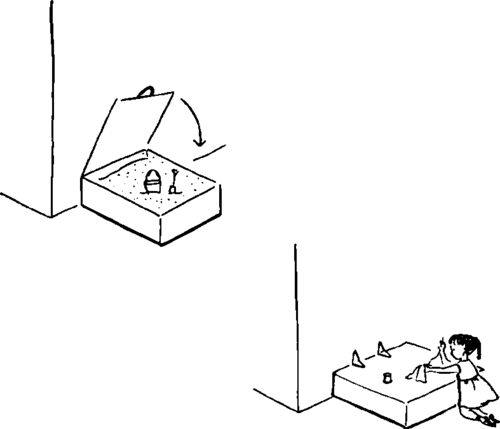
3. A cover that hooks to the side of a garage becomes a worktable when it is down.
Children who sit in sandboxes need shade.
1. The eaves of a house or the shade of a tree is a natural setting.
2. A canopy can be made from canvas.

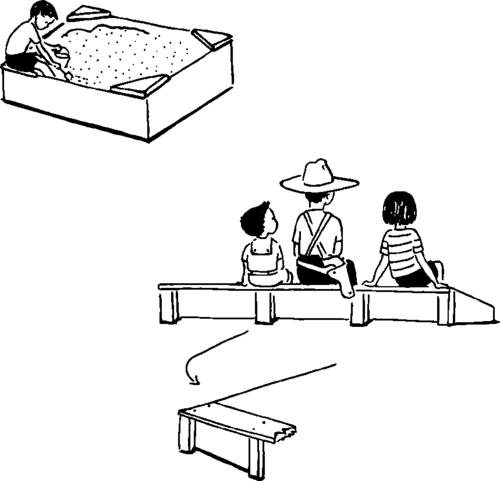
3. A 6' x 6' bamboo shade provides a filtered light And something to sit on.
Sand Rules
No fair throwing.
Brush yourself off before you come in the house. Keep the sand in the sandbox.
Ask permission to play with water on account of colds. No sterling silver in the sandbox.
Dirt And Mud
Two hills of hard-packed dirt make a good place to play Cowboy and Indian, Can't Catch a Nanny Goat, and games of that nature.
Dirt and water make mud.
Mud is a summer activity.
If you do not like mud in any amount, just turn the page-you are still a good mother.
If you don't mind a little mud, and remember your own mud-pie days with pleasure, let your children have pie pans or coffee cans for mixing.
If it's a hot day, you can squirt them off with the hose before they come into the house. Dish pans or planter boxes (sans plants) are wonderful containers for mud.
Leave a space in your yard for your children to dig. Provide garden hand tools such as a trowel, cultivator, and sprinkler.
Gravel has a particular fascination for children. They love its coarse texture and, if it is a few inches deep, will sit and run their hands through it or scoop it into piles. A gravel path from the sandbox to the playhouse makes good use of this material.
Old swimming suits make good mud costumes.
Gravel
Gravel doesn't stick to clothes and hands.
Gravel rivers or lakes will hold water longer than sand ones do.
Something To Splash In
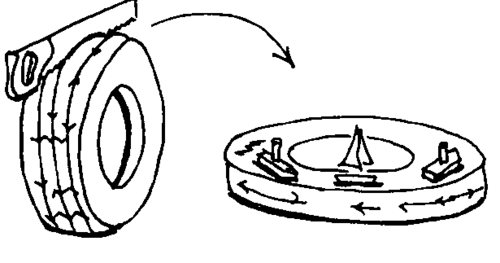
A rubber tire cut in half will make two rivers to float boats.
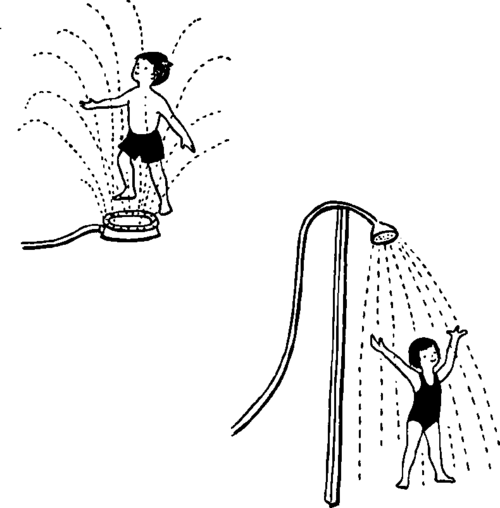
Some like their water coming up. And some like it coming down.
Something To Swing On. Pump Swings
The pump swing is highly recommended for children under five years old for the following reasons.
1. A two-year-old can get on and off the swing by himself.
2. No one says "Push me." The motion depends upon "pull with your arms, push with your feet"
3. Since it is made of light-weight wood and held together with ropes, it is safer than the ordinary swing made of board seat and chains or ropes.
4. The pump swing is often more than just a swing. Sometimes it is a bucking bronco. It is easy to ride sidesaddle.
Or be a trapeze performer.
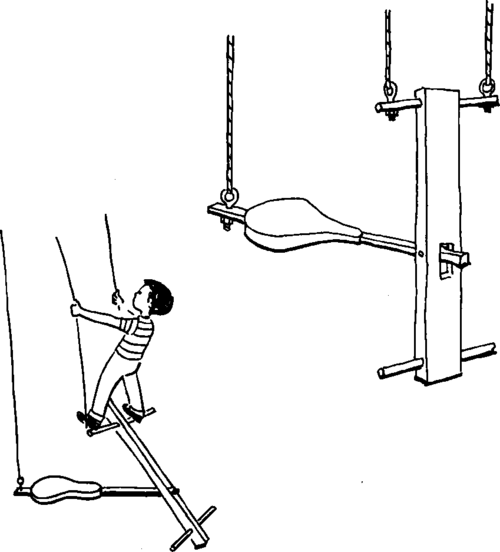
The twister-one child sits on the swing while another child turns him in circles until the three ropes are twisted several times. The child stands back while the child in the swing unwinds.
Two-man act-one child sits on the seat and the other child stands on the foot bar, facing the seated child.
Rubber Tires

Other Swings
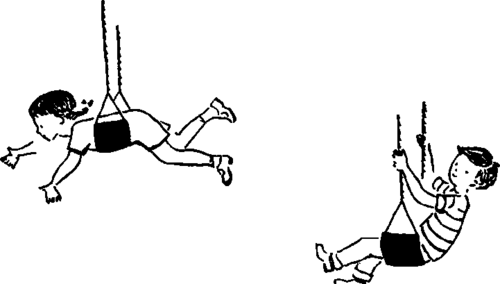
Canvas seat swings are safe, durable, and especially designed for those who like to swing on their stomachs.
A gunny sack stuffed partially with sawdust, sand, and straw goes very well with big old oak trees.

Some can swing from a knotted rope, one knot every 12"-18".
Something To Push
It is easier for children under five to have things to push, rather than pull, such as a wagon. These are all good "push" toys: Wheelbarrows
Baby buggies-one that the child has outgrown is better than the toy-store selection for dolls Strollers-same as above Inner tubes
Grocery carts-secondhand from the grocery store Dollies-secondhand or new
A Punching Bag
A burlap bag or canvas bag filled with sawdust is for pushing and punching. Tie a rope around the top of the bag and hang from tree.
When sawdust gets wet it is like a rock, so don't leave it out in the rain.
A pillow case can be used if other bags are not accessible.
An old cushion or bed pillow is a ready-made punching bag.
Something To Jump On
Dig a hole or fill one that's already there with sawdust or tan-bark. (Tanbark is shavings from oak which is used in the process of leather tanning. Its advantages are that it is a quick ground cover, it is soft, and it doesn't track on your feet)
Jump in it or over it
An old spring and mattress makes a wonderful jumping bed. If you keep it out of the rain. If you don't mind it's being unsightly.
Old car seats and Airplane inner tubes.
Continue to:


My Books

