


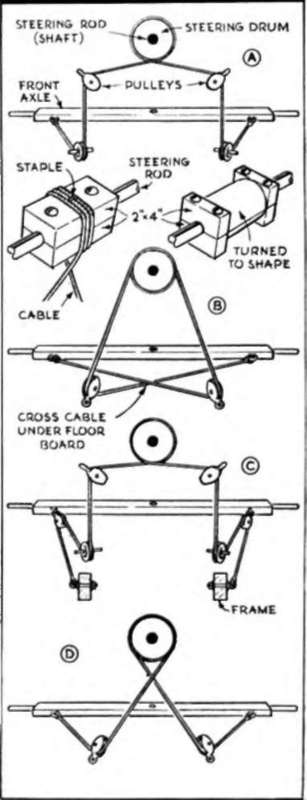
Steering
Description
This section is from the book "Boy's Fun Book Of Things To Make And Do", by Grosset & Dunlap Publishers. Also see: The Pocket Dangerous Book for Boys: Things to Do.
Steering
Running Gear
1. ;Wheels and axles may be obtained from coaster wagons, tricycles, baby carriages and other small vehicles in popular use, or may be purchased.
2. ;Homemade or hand-built wheels are prohibited.
3. ;No car may have wheels more than 12 inches in diameter, including the tires. All cars must be run on four rubber-tired wheels, like an automobile.
Wheel Camber Details

4. ;In no case shall the cost of four wheels with tires, axles and bearings exceed $6.00. (Taxes and freight, express or postage charges need not be included.)
5. ;Floating axles are prohibited.
Dimensions
1. ;Neither front nor rear wheel tread shall be less than 30 inches or more than 36 inches. Front and rear treads do not have to be the same.
2. ;Every car shall have a wheel base of not less than 40 inches.
3. ;The over-all length of the car shall not exceed 80 inches.
4. ;The over-all width of the car shall not exceed 42 inches.
5. ;The over-all height of the car, including the windshield, shall not exceed 30 inches. Only the steering wheel may extend above the allowed over-all height.
6. All cars must have a road clearance of at least 3 inches with the driver in the car.
Weight
The entire weight of the car must be made up of parts and materials actually used, and necessary, in the construction of the chassis and body. The car by itself shall weigh not more than 135 pounds. The combined weight of the car and the driver must not be more than 250 pounds.
These are by no means all the rules, but should give you an idea of the thoroughness and fairness with which the competitions are based. There are other rules governing age limits and the construction of the rest of the car parts, down to the smallest detail, but you won't find them hard to follow. As a matter of fact, you'll find them very helpful in building an inexpensive, safe racing model, whether you're interested in competing or not.
Fun With Paper. A Windmill The Tiniest Tot Can Make
For making this attractive little windmill model, the best kind of paper to use is a rather heavy type of drawing paper-the sort that will stand up well.
Placing the sheet of paper flat on the table, draw two "windows" (preferably with crayon) -one near the top in the right-hand corner, and the other in the corresponding spot in the left-hand corner. In the lower center draw a "door." The size of the windows and door will depend, of course, upon the size of the paper.
Cut two strips of fairly stiff paper for the windmill effect. Crisscross them, and in the middle of the X they form fasten them to the top center of the "house." (They can be fastened with ordinary paste, a staple or even a straight pin.) Next, roll the sheet of paper around until the sides overlap a little, and fasten them with either paste or paper fasteners. Stand your house up, and there it is-a complete little windmill, not designed actually to turn with the wind, but merely to serve as a simple model or decoration.
Continue to:


My Books

