


Sealing Wax Gifts
Description
This section is from the book "Suggestions For Decorating And Entertaining On Christmas, New Year's, Twelfth Night", by Dennison Manufacturing Co. Also available from Amazon: Dennison's Christmas Plays When the Little Angel Sang.
Sealing Wax Gifts
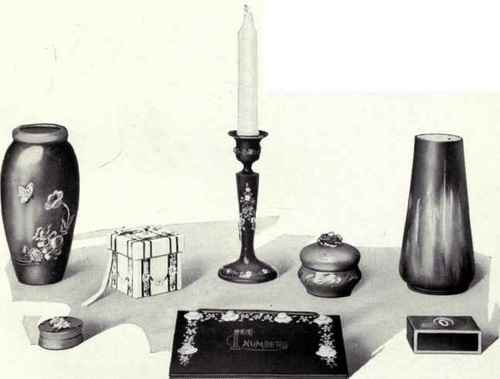
Your friend who "has everything" will appreciate the novelty of a sealing wax gift and admire its beauty. In fact, you may thus please all your friends at a small outlay of time and money. The only materials needed to make many and varied gifts are an alcohol lamp, a few steel knitting needles, a steel knife, a wax spatula, a wax moulder and a few sticks of Dennison's Sealing Wax.
Bead necklaces are very popular. Vases are a close second. Decorated boxes, candlesticks, telephone and memo pads, all are serviceable as well as pretty. Flowers, figures and conventional designs may be reproduced for decoration. Beads are made by twirling wax on a steel needle over the lamp flame. Other objects are covered gradually with wax and twirled over the flame. For flowers and designs the spatula is used.

Send 10 cents to Dept. X for Dennison's booklet, "Sealing Wax Craft"
General Directions for Working
Before starting to decorate have all working materials handy,- scissors, hammer, tacks, pins, wire, glue and paste.
Work for effect. Finish the general decoration. Then, if time permits, give fine touches.
If the decorations are ever to come down, drive the tacks in only halfway. They will hold perfectly well. Wire is better than string for attaching decorations and for holding things together. Two twists hold when a string slips in tying.
Crepe paper almost always is stretched a little before using. This should be done by two people, one at either end of the paper. First, double the end over once or twice or, better still, roll it over a ruler or stick so that it will not tear, and then pull steadily until it is sufficiently stretched.
In covering a background in plain effect, fold over the top edge of the paper once or twice; then tack, lapping the second piece
3/4 inch and so on. When the top is finished, stretch crepe down smoothly and tack at the bottom.
Hang the dull side out, for Dennison Crepe will hug tightly that way, as it tends to roll in. If the height to be covered necessitates tight stretching, tack through little pasteboard squares or pasteboard strips so that tacks will not pull through the paper. (The back of the cardboard folder in which Dennison Crepe is sold is printed with lines and inch measurements for easy cutting.) Ruffled or fluted edges can be made evenly and easily without removing the paper entirely from the packet. Pull all edges at once back and forth between the thumbs and forefingers, thus producing a rippled effect.
Ruffles of crepe may be easily gathered on the sewing machine. Always use silkateen when stitching crepe paper by hand.
Fringe: Cut a fold of crepe paper across the grain of the crepe into length required for the fringe. Fold one end up to within 1 inch of the other end. Fold and refold until you can cut handily, leaving the 1-inch border. Shake out fringe. Crushed Crepe: Stretch crepe. Lay on smooth surface. Take up a small section with tips of fingers of both hands, crushing it tightly. Repeat over whole piece of crepe.
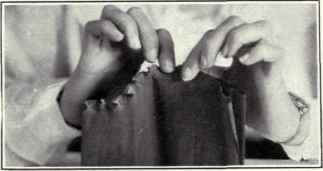
Fluting Edge
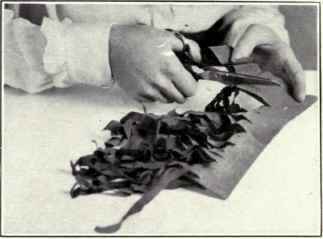
Cutting Fringe
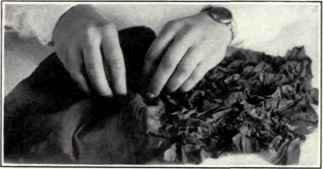
Crushing Crepe
Continue to:


My Books

